









‘You either win or you learn’: Nick Johnson’s courageous college football story endures at Earlham

Indiana University head football coach Curt Cignetti nailed it when he said late in his team’s storybook 2025-26 season, “It’d be a hell of a movie.”
But as fine a fit as the undefeated national championship run seems for Hollywood, there’s another one just a couple of hours from Bloomington, flying under the radar in a state with a tradition of memorable sports films from Breaking Away to Hoosiers to Rudy.
It’s a tortuous and nuanced underdog journey, a labyrinth of love, loss and the longest of long shots. The protagonist’s path and denouement stand in deep contrast to the stunning rise to the top for Cignetti and IU and those silver screen triumphs against the odds.
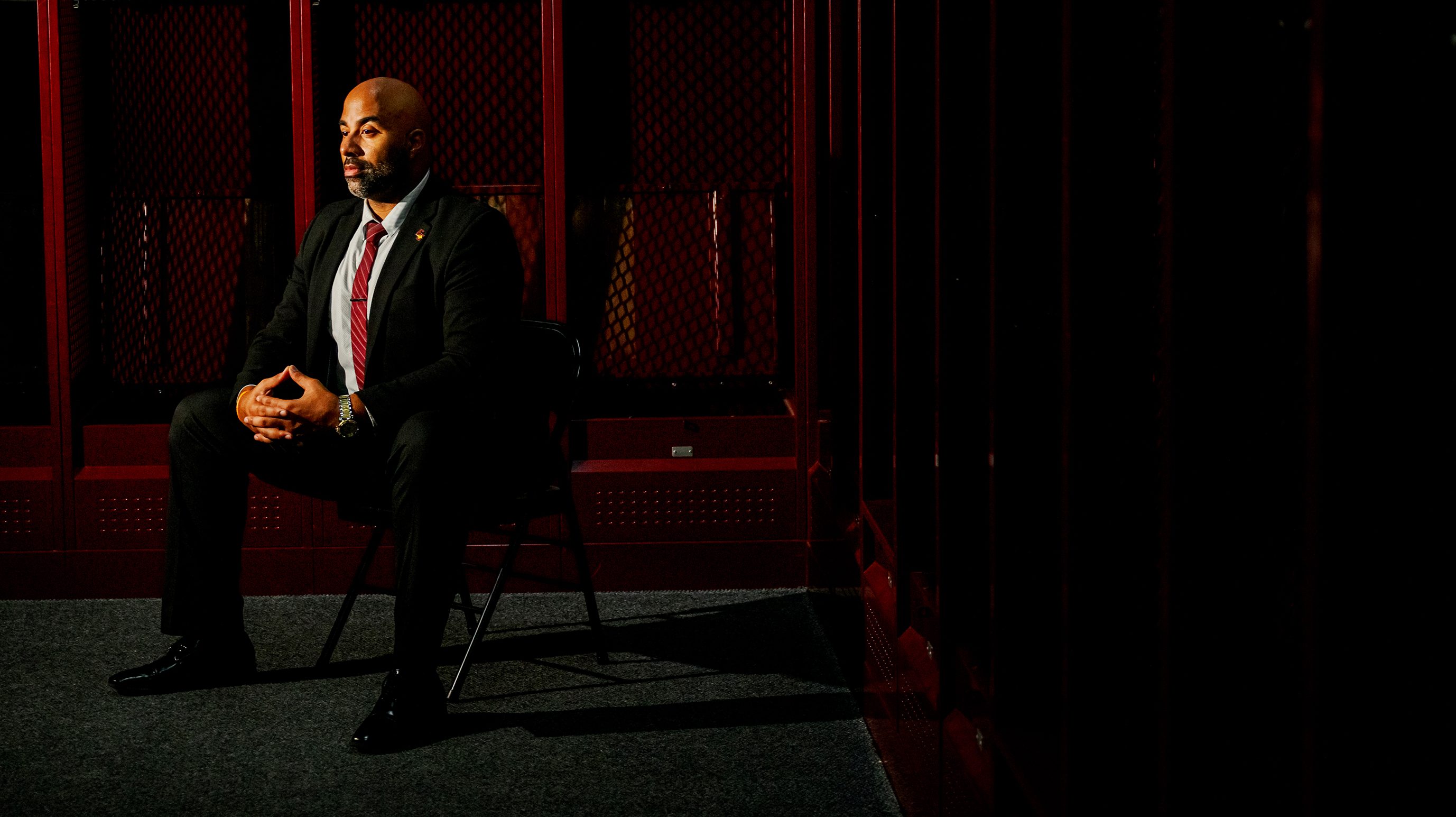
The story belongs to Nick Johnson of NCAA Division III Earlham College in Richmond, Indiana. He shares Cignetti’s football passion and meticulous devotion to getting everyone in his charge to maximize every moment. But Johnson, 47, hasn’t coached a game this decade. And he totaled six fewer wins in his head coaching career than Cignetti, 65, had in the single worst year of a career that’s in its 16th season.
Those who know Johnson portray him as the antithesis of the legendary Bill Parcells pronouncement that “you are what your record says you are.” They say scoreboards and win-loss ledgers are misleading measures of the man — otherwise, he might have been defeated by defeat after defeat or succumbed to the crushing Sisyphean struggle he faced away from the football field.
Steve Sakosits, Earlham’s longtime baseball coach and Johnson’s close friend, said, “Realizing everything Nick’s been through, I would say this story is something that even Spielberg probably couldn’t create.”
Johnson, who happens to be a movie lover, recently spoke with Andscape at length about his life spent entirely in Indiana and the precious peaks and precipitous valleys of his years at Earlham.

Johnson Family
Johnson and his twin brother, Nate, grew up in Fort Wayne, where their family was “like a lot of people in that area, having a hard time making ends meet, not certain if there was going to be food on some days,” Johnson said.
After the boys shared a pullout couch in the living room of the Johnsons’ one-bedroom apartment for about the first 10 years of their life, a drug raid on a neighbor spurred their father to move the family to a safer side of town.
Still, the Johnsons had challenges to navigate.
“We were a mixed family, with a white mother and Black father, and all of the societal issues that came with that then,” Johnson said. “So we just kind of pushed and strove our way through things as a family.
“My mother was a saint, the daughter of a coal miner and tobacco farmer in Saltville, Virginia. And my dad was a man with a difficult past, a sharecropper’s son who worked odd jobs to get from Alabama in the Jim Crow South all the way up north. He had struggles with alcohol, but was a good man and one of the hardest workers I ever knew. He would get up at 3 a.m., 2 a.m., go to work and just get mistreated on the job site, called out of his name, dealt with racism, racial slurs, but worked so hard anyway for very little pay.”
Overall, Johnson said his parents “did the very best they could [and] they did an excellent job in teaching us to appreciate life, appreciate the things that we have, and to be good people. I remember that.”
Of their two sons, though, only one seemed to have the makings of a college football player — and it wasn’t Nick.
“I wasn’t very good,” he said. “I was a 6-foot-3, 205-pound outside linebacker and easily tossed aside by better players. Academically? Even worse. I think that I was smarter than I gave myself credit for, but I was not a great student. I didn’t really apply myself as well as I could have.”
What Johnson did have going for him was his identical twin, Nate — younger by two minutes — who drew interest from several colleges, including Earlham.
“He was a 6-2, 255-pound all-city center,” Johnson said. “And our [high school] coach said [to an Earlham coach], ‘These guys are twins, you’re going to want to meet the other one — he’s not very good, but he’s a good guy and great for your team and a good program guy.’”
Academically rigorous Earlham, which had just two winning seasons in the previous quarter-century, bit.
“I convinced my brother that since this was the only school recruiting me, that’s where we had to go. So, due to separation anxiety, they got both of us,” Johnson said.
Earlham, like all Division III programs, wasn’t allowed to provide athletic scholarships but did offer financial aid packages. “The books and certain fees weren’t covered, but tuition, room and board were,” said Nate, who also described his brother as a “never give up” player whose “motor never stopped.”
“I asked Nick [during our visit], ‘Can you do this, do you want to do this, do you want to play ball here?’ He said, ‘Absolutely.’ I said, ‘Well, it looks like we’re going to be Earlham Quakers.’
“I was overjoyed that a school wanted him, because it gave me a chance to play with him.”
Before starting classes in 1997, Nick and Nate were enrolled in Earlham’s intensive August orientation. The preparatory program served incoming freshmen, including international students, athletes and fellow first-generation college attendees.
The Johnsons recall it being an invaluable foundation for their time at the small liberal arts college, which Nick said “felt like a world away” from the Fort Wayne surroundings they were used to, despite being separated by less than 100 miles. He noted that relatively few of his high school classmates had similar educational opportunities.
Bonita Washington-Lacey, who ran the program then and is to retire next year as Earlham’s vice president of student life, said she assured the twins’ parents, Mary Sue and Roosevelt “Jake” Johnson, that she’d look after Nick and Nate and help them succeed.
“It was clear that they had high expectations of their sons, that they expected them to be generous, gentlemen and considerate,” Washington-Lacey said. “And they were good athletes, but the education came first.”
The unexpected death of the Johnsons’ uncle — their father’s brother and best friend — pulled them home to be with their mourning family. But they returned days later, completed their requirements and began four years of college, football and track. Both eventually became track team captains.
“We were inseparable. We were wombmates and then roommates for 23 years, so it was a great experience,” Nick said. By the time they graduated, the identical twins and teammates would also meet two women – Earlham teammates with almost identical first names – who would change their lives.
Jon Cherry for Andscape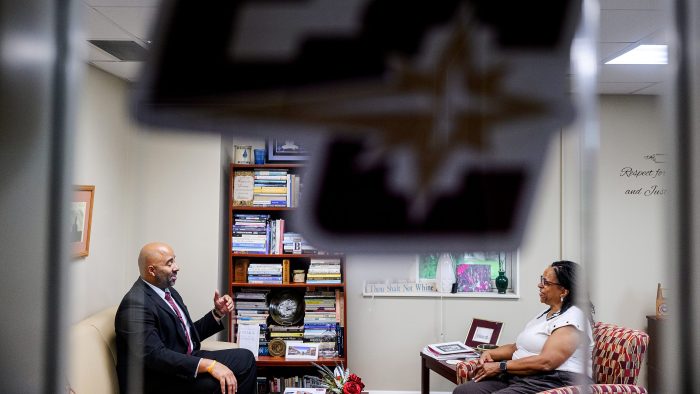
During their first few months at Earlham, they heard from their father daily. Johnson said a typical Jake call was: “Are you doing your work? This ain’t free, so make sure you’re getting it done. Don’t waste people’s time, don’t waste those coaches’ effort and energy, don’t waste what we’re putting into you.”
Jake also attended their games freshman year and wore an Earlham alumni sweatshirt, explaining that paying part of his sons’ way meant “it’s my degree as much as it is theirs,” as Nick recalled
“And through that story,” Johnson said, “I recognize how he lived through us, and there were opportunities, based on his lack of education, based on his skin tone, based on where he is from, that were never afforded to him. So I just never take for granted the opportunities that I have.”
Nick and Nate’s first season at Earlham was the only one their father lived to see. Jake died of a heart attack at age 58 in January 1998, nine days after his sons turned 19.
“That was a hard run for our family — funeral after funeral of two really good men that we all loved,” Johnson said. “I learned a lot in that time — that you never know how strong you can be until you have to be that strong.”
Johnson struggled in the immediate aftermath of his father’s death, describing himself as “really depressed.” It affected his academics, and he needed “a couple of ‘come to Jesus’ meetings” with professors to get him back on track.
That semester turned into one of his best academically, Johnson said, a showcase of one of his favorite aspects of the school: “I just love that place so much, because once you’re there, they really invest in you.”
Earlham had a 2-8 record in each of its first three seasons with the Johnsons, then went 6-4 in 2000. Nick gained about 20 pounds in his four years and developed into a top defensive lineman, leading the Quakers with nine sacks his senior year and tying a school record with four in one game.
A tradition among seniors on the football team before their last game was to paint a fresh coat of maroon, the school color along with white, on the “pride rock” between the locker room and the field, and to bury mementos of deep personal meaning next to it. In the fall of 2000, seniors Nate and Nick chose to bury their dad’s Earlham cap and alumni sweatshirt. It was at the same spot two years later that Nate would propose to his future wife, Melanie Behler, a member of the Earlham women’s basketball team.
“Nick had made himself into the best person he could be, the best athlete he could be, the best student he could be,” said Nate, who is the executive pastor of a church in Cincinnati. “Our head coach, Frank Carr, said at the football banquet — I’ll never forget it — that ‘Nick Johnson got the most out of his Earlham College football experience of any kid that he had coached before.’ ”
When he was a junior, Nick tried to make the most of a first encounter with Melissa Liffick, a freshman basketball player from Whiteland, Indiana. As Nate, an eyewitness, recalled: “She was walking, dribbling a ball down a corridor and Nick — being the flirt and guy that he is — thought he’d square up on her and work a little defense. And she outmaneuvered him, dribbled around him and just kept on going about her day.”
“I thought she was crazy. I’m a catch,” Nick said jokingly, adding he was undeterred and then encouraged when he learned Liffick was the roommate of his buddy’s girlfriend. “She said Melissa was interested in me but was shy and never going to say anything.”
Johnson ultimately called to ask her out and they went on a double date with another pal and his girlfriend — meeting them at a movie theater, where they found out the friend had gotten four tickets to Ready to Rumble, a comedy centered on professional wrestling. No problem for Johnson, who was a big fan, but Liffick wasn’t thrilled. The best she could muster was that she watched it as a kid.
Johnson Family
Dinner afterward was at McDonald’s — Johnson’s friend’s choice — and Johnson, who didn’t have a car and was riding in his date’s, came to realize he had forgotten to bring his wallet.
“It was the worst date imaginable, but ‘Mel’ called me the next day,” Johnson said.
They went on to date for two years, until she felt he was too needy and she wanted a break to focus on her studies and sport. Johnson said she had a change of heart six months later.
“She said, ‘Let’s try again.’ It was almost a God thing, like a spiritual call to her.”
ESPN
Mel was his best friend, compass and soulmate, he said. She was also a leader of her team, serving as the Quakers’ captain for three of four seasons and receiving defensive player of the year honors twice. But before her 2003 graduation, she had a pulmonary embolism and almost lost her life.
“I couldn’t imagine life without her,” Johnson said. “I decided to propose, got her parents’ blessing and told my mom and brother. Then Mel and I were at my apartment, and I showed her a box with every letter and every card she had ever written to me. She was much more intimate in her writing.
“She said yes, then immediately called her parents, and they said they knew already.”
Soon after the couple got married in 2005, Mel suffered a cerebrospinal fluid leak. The Mayo Clinic in Minnesota surgically sealed the hole, but she also endured Ehlers-Danlos syndrome, a hereditary connective tissue disorder that was causing aches and pains.
While managing through those health challenges, Mel earned a master’s degree in teaching at Earlham, worked as a teacher and then became her alma mater’s assistant basketball coach. Nick was an assistant men’s and women’s track coach for two years, then head coach for 11 while also a football assistant most of that time, including five seasons as defensive coordinator.
The Johnsons decided to try to start a family, and a year after Mel had a miscarriage, she gave birth to daughter Jayden in 2008 and then son Jacob in 2010. Mel was named head basketball coach in 2011 and, said Johnson, for two years “she was living her best life, running 5Ks and mini-marathons, and we were the prototypical two-coach household.”
Jon Cherry for Andscape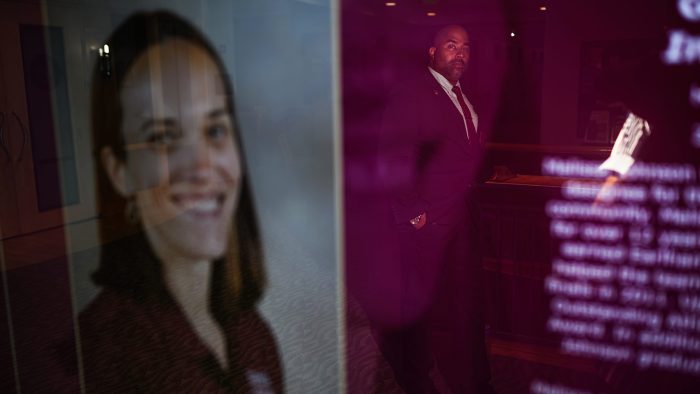
But Mel’s health took a turn for the worse. It began with pancreatitis and became a years-long ordeal of ambulances and even a helicopter, hospital stays and surgeries, an array of ailments of the internal organs, blood clots and brain swelling, rare conditions, tubes and lines, suffering and seizures. Johnson said he lost track of the numbers of operations after the 13th and nights of hospitalizations after about 1,000.
As the Johnsons dealt with crisis after crisis, ins and outs at hospitals near and far, and raising their young children with the crucial support of family, friends and the community, Nick received an offer he intended to refuse.
“It was very much a Rocky and Adrian moment from Rocky III,” Johnson said about telling his wife that he planned to turn down his dream job: head football coach at Earlham. “They’re meeting on the beach, Rocky’s been training with Apollo and he just doesn’t feel like he can get it done. And Adrian asked him to say what the truth was — that he was afraid, he was scared to fail.
“And when we got to the heart of that, Mel said, ‘What if you never try and never know?’ That was a very seminal moment for me, her asking me that question. Could I live with the rest of my life knowing that this was in front of me, something I always wanted, but the fear of failure held me back?
“She was 100 percent right. She knew how we were both wired.”
Johnson Family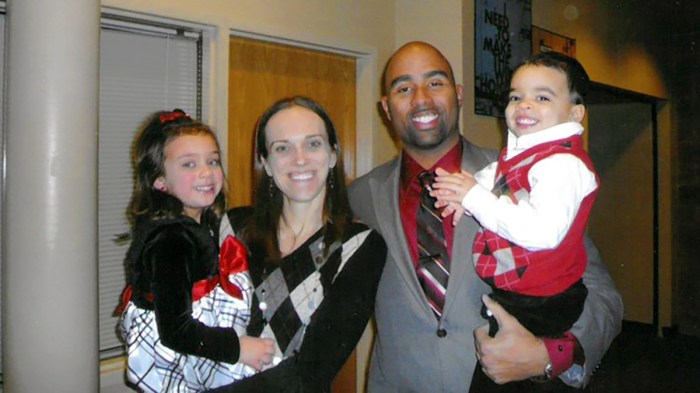
Johnson, who was solely the head track coach for two years, accepted the job to turn his attention just to the football program in 2015. It had lost 13 straight games and hadn’t had a winning season since 2000, his senior year.
The reality awaiting him was more daunting than the weight of dubious history. Earlham, facing an enrollment decline, fielded far fewer players than its opponents, lacked comparable workout and weight-training facilities, and severely limited coaching salaries and travel budgets, including meals. Furthermore, the school was less inclined to admit and nurture a slow-to-mature student-athlete like its new coach was.
“It was almost an impossible task, not just with wins and losses, but with recruitment of enough players,” Washington-Lacey said of the mission Johnson undertook to uplift Earlham’s undermanned, undersized and underfunded program. “He took it on because of his commitment to the college, commitment to the sport, commitment to those students.”
From the start, Washington-Lacey and others marveled at Johnson’s work ethic and how little he slept. He was a hands-on coach and a deeply involved father to his two young children. He was constantly going with and without them to be at Mel’s bedside. She was on medical leave from coaching after steering the team in her third season to its best record in 11 years.
Johnson somehow found time to maintain an open-door policy for one-on-one player meetings, join his “football family” in the weight room, and offer encouragement at study sessions. On some days, players recalled, he would study film at 4 a.m. before getting his kids ready for school.
“If we didn’t know the situation he was dealing with, you never would have known. That’s how incredible he was. He was such a rock,” said Joe Enwright, one of Johnson’s first recruits. “He was always such a bright and positive person. He’d run onto the field at the start of practice and yell at the top of his lungs, ‘It’s a great day to be alive!’ ”
Johnson learned that daily rallying cry as a player under Carr and he paid it forward to his own players. He also created a metaphor to deliver a message he was living.
“A wall of adversity,” Enwright remembered, having heard it for four years. “It stares you in the face. It’s not going anywhere. You can’t go over it, you can’t go under it, you can’t go around it — you have to go through it. There is no other way.”
Johnson said, “You never know how thick it is, but dig through the wall, because success is on the other side.”
ESPN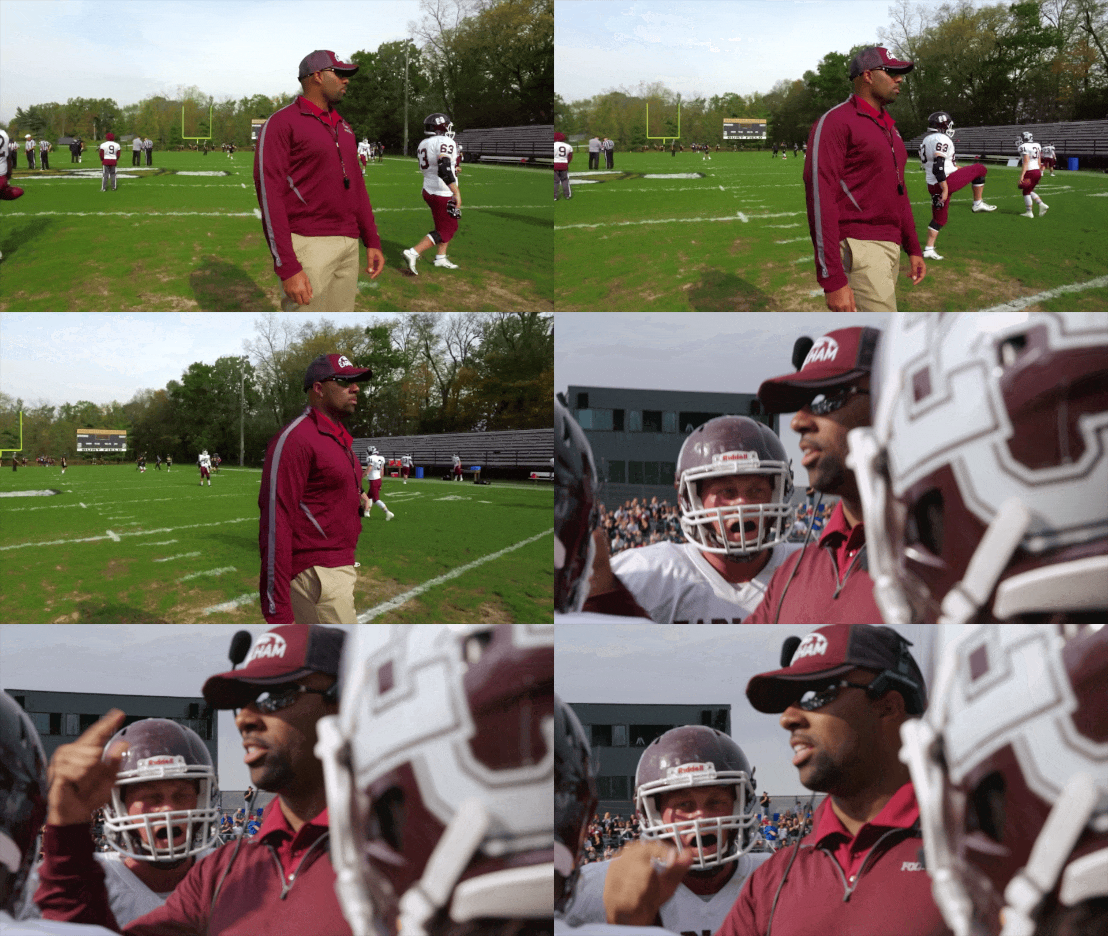
The 2015 Quakers didn’t achieve success on the scoreboard, finishing 0-10 with nine losses by more than 30 points and one by a single point, extending the school’s streak of adversity to 23 games. Because Earlham’s roster of about 40 players was less than half the size of its opponents’ squads, individuals routinely played on offense, defense and special teams.
Earlham’s determination and its rookie head coach’s perseverance made an impression on opponents. Shortly after the season ended, Johnson’s peers in the Heartland Collegiate Athletic Conference did something remarkable.
Before their postseason awards call, Mike Leonard of Franklin College in Indiana – then a five-time HCAC Coach of the Year who had just completed an undefeated conference season and won an eighth championship in nine years — contacted every coach but Johnson about one of the honors.
Then, on the group call, after the other awards were announced, they revealed the coach of the year to the amazement of its recipient: Nick Johnson.
“First words out of his mouth,” said Leonard, “were ‘Excuse me. Am I hearing this correctly?’ And seven other coaches chimed in, ‘Yes, Nick, you are the one.’ That was one of the greatest moments I can think of.”
Johnson told the others he couldn’t accept the award, and Leonard replied, “Too bad. We voted.”
“They were 0-10, but who did the best coaching job?,” Leonard said. “All of the other coaches were aware of Nick’s situation and all were in on this. Nobody could have done a better job coaching the Earlham Quakers.”
Johnson said he’s never commented publicly until now about that 2015 call or his reaction.
“That was a great group of men. They said it was non-negotiable, so I accepted on behalf of our staff, which did a lot of the work to ensure we got through the season,” Johnson said. “I didn’t want fanfare. I felt like that needed to be earned and it might have been perceived as, ‘We feel bad for this guy, dealing with all this other stuff and can’t win a game, so we’ll make him coach of the year.’
“But with reflection, I realized it was admiration and respect within the league, and so I hold it in great honor that they saw fit to bestow that upon our staff.”
Johnson coached Earlham for the next three seasons. Despite occasional signs of progress, the Quakers failed to win a game, usually losing by large margins. The losing streak reached a Division III-record 53 games, including 40 under Johnson.
Meanwhile, except for a brief return to coaching during the 2017 offseason, Mel remained mired in an unrelenting medical storm.
“Her thing was, ‘Hope. Hold on. Pain ends,’ ” said the Johnsons’ son Jacob, 16, a Richmond High School student, football lineman and discus thrower. “At some point the pain is going to end, whether you’re healthy or you’re not, so you might as well fight through it. And she definitely fought through it.”
Daughter Jayden, now 18, said, “I think that not only did my dad instill courage in my mom, but my mom instilled courage in my dad. There were many times where my dad himself was scared and my mom would be like, ‘You don’t need to worry. I got this. We’re going to get through it.’
“My dad made sure he was never too busy to be there for my mom, no matter what was happening. He was always by her side. He learned everything he needed to know in the medical field. I remember him studying at home, so if my mom couldn’t speak, he could.”
Johnson’s actions spoke volumes to his players.
“There were times Coach Johnson would drive [250 miles] to the Cleveland Clinic after practice and be back for the next day’s practice,” said Luke Brake, who played for Earlham in 2017 and 2018. “He was still the one in the locker room some days at 4 a.m., hanging up jerseys for practice, taking laundry out of the washer, putting it into the dryers, putting it in people’s lockers, setting up tackling dummies.”
Nate said he used to look at Nick and think to himself, “Man, is it worth it?
“And he’d just keep chopping wood,” Nate said. “He loved what the game could do for people’s lives, what it did for his life, my life, how it builds men’s character and reveals it. And maybe even the bigger reason, he loved those kids.”
Said Johnson: “I failed them as a coach and leader in terms of victory on the playing field, but I hope they still feel to this day that I served them as their head coach, as a mentor and as a friend and counselor.
“I know we lost a lot, but I would do it again in a heartbeat. I used to tell the student-athletes, we either win or we learn. I never told them we win or we lose. And so, at 0-40, I think I’ve learned more than anybody.”
Enwright said although the Quakers weren’t winning any games, Johnson exuded a winning culture. And Jordan Christian, who played three years for him, said Johnson’s influence was unbelievably positive and defined the coach as a role model and a winner.
“Had I not played football, I wouldn’t have met Coach Johnson,” Christian said. “I would have regretted that more than the losses.”
Jon Cherry for Andscape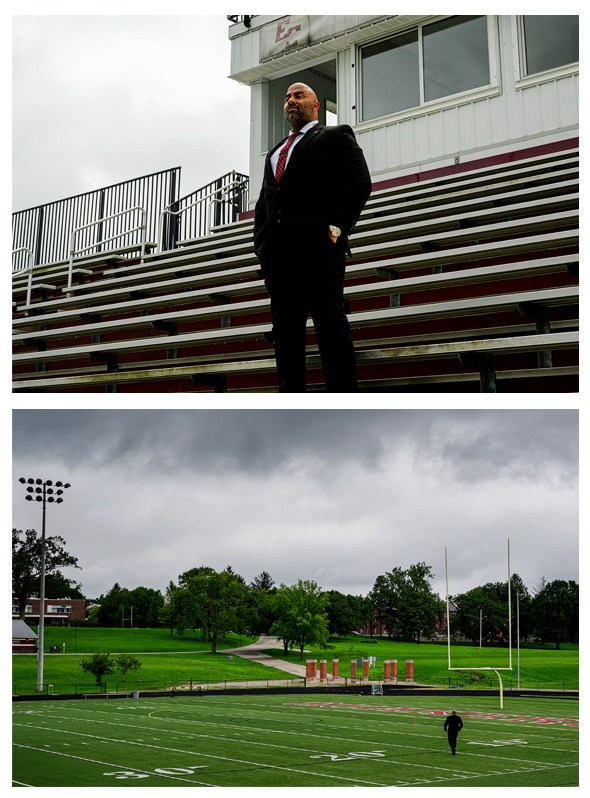
Bottom: Johnson played four years for the Quakers as a defensive lineman and led the team in sacks his senior season of 2000. That was the last time Earlham had a winning record.
Johnson is tight-lipped about placing blame anywhere other than on himself for all the losing, only saying winning requires alignment in philosophy at all levels. A key change since his undergraduate days was largely at fault for a no-win situation, according to his brother.
“You wouldn’t give us a snowball’s chance in a blast furnace to make it out of a top liberal arts college, but we did because we had the support of the coaches, staff, administration, registrar, president — all the people at Earlham,” Nate said. “Nick was promoting that, but he needed support in doing that, and that’s where I think the school failed him.”
Jon Cherry for Andscape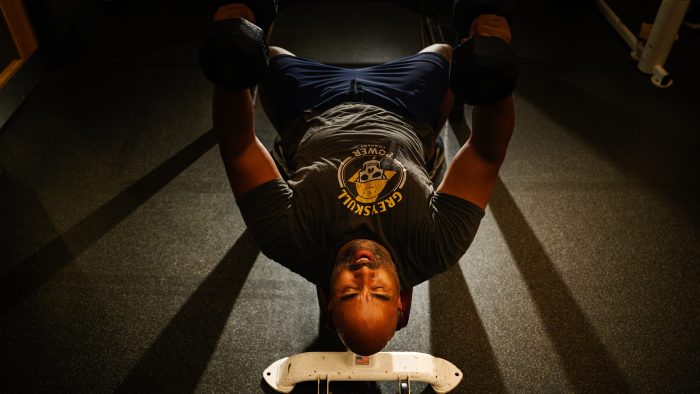
Late in his fourth season as head coach, with Mel in need of lifesaving organ transplantation, Johnson decided he was going to step down.
“I didn’t think it was fair if I couldn’t give it my all, and I wanted to leave it in the good hands of the staff,” he said. “The last week of the 2018 season, I was in Cleveland with Mel and had coordinators run everything. I let the guys know how much they meant to me. We got destroyed at Rose-Hulman, which won the conference, and they let us gather in the middle of the field as they celebrated with their fans.
“I told the team to fight for one another, to stay together, that the next coach can get it done — that I loved them and there was nothing they could do about it.”
Days later, Earlham announced the end of its 129-year-old football program.
“It felt like a piece of me died,” Johnson said.
In Part 2 (Tuesday, Sept. 22): What Nick Johnson decided to do with his career and life after Earlham shut down its football program. And the fate of his beloved wife Mel.
The post ‘You either win or you learn’: Nick Johnson’s courageous college football story endures at Earlham appeared first on Andscape.
What's Your Reaction?
 Like
0
Like
0
 Dislike
0
Dislike
0
 Love
0
Love
0
 Funny
0
Funny
0
 Angry
0
Angry
0
 Sad
0
Sad
0
 Wow
0
Wow
0