






Trump signs new order ending ‘birth toursim,’ recycling citizenship argument about ‘babies of slaves’



After the Supreme Court rejected his birthright citizenship order, President Trump is pursuing narrower executive actions expected to face court challenges.
U.S. President Donald Trump resurrected his crusade against birthright citizenship, signing new executive orders to limit the 14th Amendment constitutional clause and “birth tourism.”
The orders, “Continuing to Protect the Meaning and Value of American Citizenship” and “Ending Birth Tourism,” come after the U.S. Supreme Court ruled against Trump’s order ending birthright citizenship. The June 30 ruling asserted, “The Framers of the Fourteenth Amendment extended that promise to ‘every free-born person in this land.’”
The new executive actions appear to be Trump’s legal workaround, limiting their scope rather than an outright ban, which the Supreme Court deemed unconstitutional.
Trump’s order to “protect and meaning and value” of U.S. citizenship identifies categories of “children of aliens who do not fall within the rule of birthright citizenship as announced by the Supreme Court.” Those categories include when one of the child’s parents is an ambassador, an employee of a foreign embassy or consulate who is a national of that foreign country, or an employee of a foreign government or international organization, among others.
The other order attempts to crack down on foreigners who seek to obtain non-immigrant visas “for the purpose of giving birth within the Nation’s borders.” The order especially calls out “birth tourism operators” who “use deceptive advertisements and inducements to entice foreign nationals to travel to the United States for the purpose of giving birth on American soil.”
While announcing the executive orders in the Oval Office on Thursday, President Trump called the Supreme Court’s ruling “very unfortunate” before saying he was “making adjustments” to his agenda to revoke birthright citizenship.
“This was done for a different reason,” he said of the 14th Amendment citizenship clause. “This was done right after the Civil War. This was for the babies of slaves.”
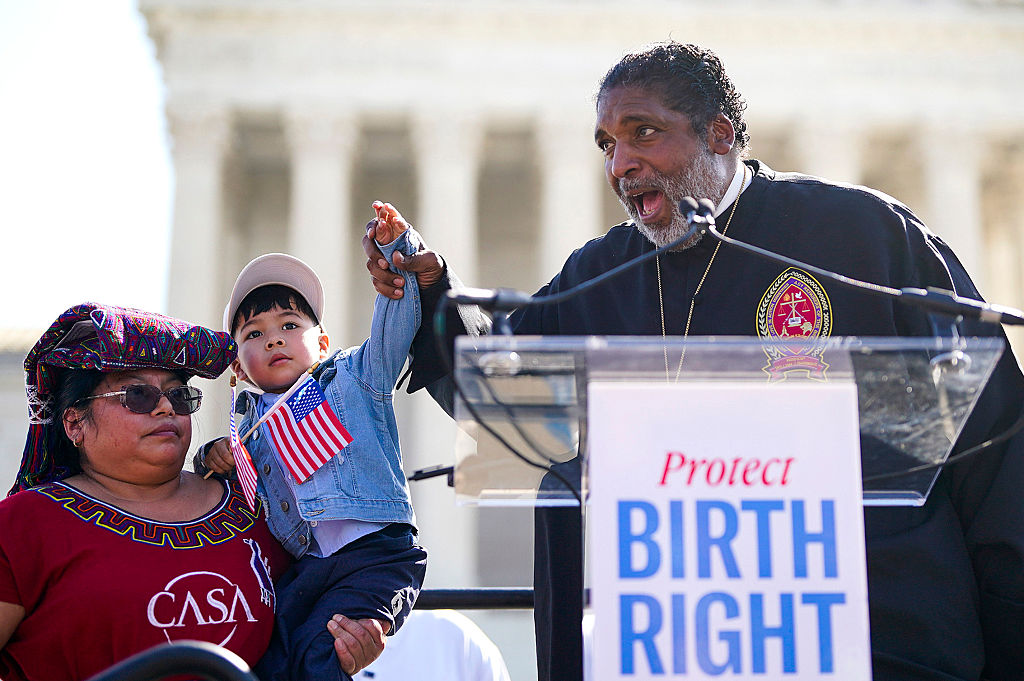
On the issue of “birth tourism,” the president claimed that people are “building businesses around” abusing nonimmigrant visas—temporary travel documents for foreigners visiting the United States.
“That’s not the way it was supposed to work. It’s a disgrace. They’re buying their way in, and we’re not going to let it happen,” said Trump.
Trump’s new orders are likely to face legal challenges, as did his original executive order that was ultimately struck down by the Supreme Court.
In her concurring opinion in Trump v. Barbara, Justice Ketanji Brown Jackson scolded the Trump administration’s legal argument that the birthright citizenship clause under the 14th Amendment was only intended for the children of former enslaved Black Americans, who had fought in the bloody Civil War that ultimately led to their freedom from U.S. chattel slavery.
“That narrow vision of the Fourteenth Amendment bears little relationship to the history of its ratification,” writes the high court’s first Black female justice. “The Reconstruction Amendments were an anticaste, antisubordination reset for the Nation, not a mere spot treatment for the dark stain of slavery.”
Justice Jackson pointed out that even after the Civil War and subsequent victories in gaining citizenship, Black Americans faced discrimination, much like immigrants of today — including efforts for them to self-deport to Liberia, the first independent Black republic in Africa.
Despite this unique discrimination, Jackson notes, “Freed Blacks did not advocate for a unique set of rules that catered only to their situation. Nor did they seek to advance their own position relative to, or at the expense and exclusion of, other marginalized groups…The firmest foundation for freedom would require an anticaste reset—’both for his sake and for ours’—and would benefit all.”
What's Your Reaction?
 Like
0
Like
0
 Dislike
0
Dislike
0
 Love
0
Love
0
 Funny
0
Funny
0
 Angry
0
Angry
0
 Sad
0
Sad
0
 Wow
0
Wow
0