![Trump Didn’t Win The Nobel Peace Prize, So He’s Helping Smear The Woman Who Did [Op-Ed]](https://newsone.com/wp-content/uploads/sites/22/2026/10/17915758433969.jpg?quality=80&strip=all&w=1024&crop=0,0,100,683px#)







The WNBA’s Uneven Whistle Continues To Put Black Women In Danger [Op-Ed]

![The WNBA’s Uneven Whistle Continues To Put Black Women In Danger [Op-Ed]](https://newsone.com/wp-content/uploads/sites/22/2026/08/17863865807191.jpg?quality=80&strip=all&w=1024&crop=0,0,100,684px#)
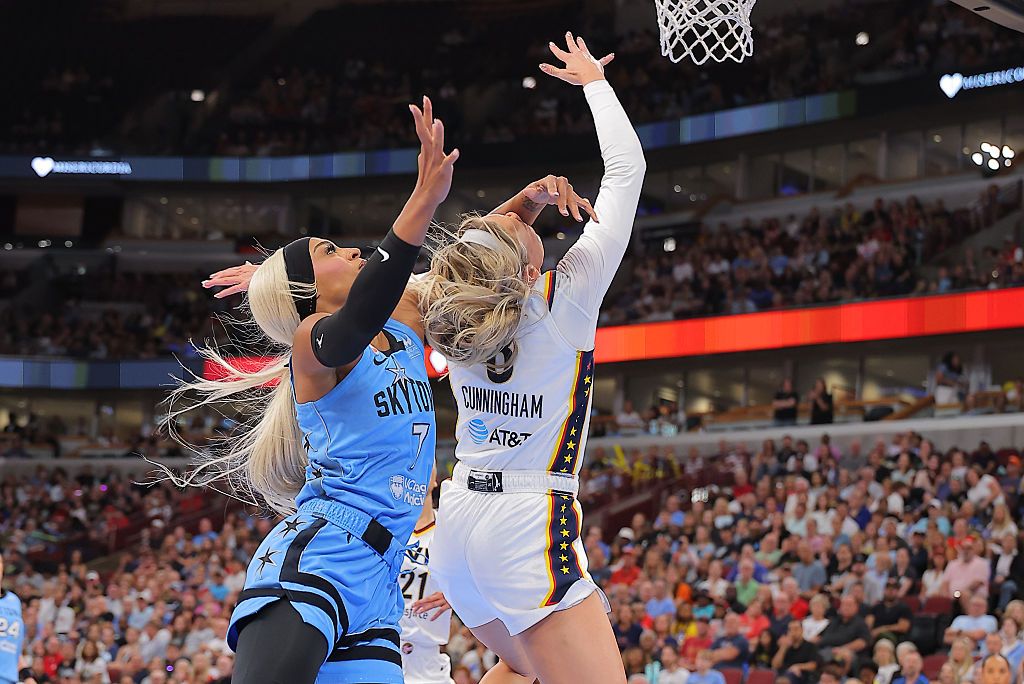
This piece was supposed to be about Indiana Fever guard Caitlin Clark’s suspension after being called for her eighth technical foul during the third quarter of the Fever’s matchup against the Chicago Sky on Saturday. Before we could get the news written and published, the WNBA had rescinded the technical and the suspension intended to accompany it.
It was a game fraught with physical play and controversial rulings from officials and a league that is increasingly developing a pattern of uneven officiating that bends depending on who is on the receiving end of the whistle. This pattern benefits white players while coming at great risk to the integrity of the game and is putting the safety of Black players in jeopardy both on and off the court.
The uneven officiating showed up early in the game in a physical exchange between Chicago Sky star DiJonai Carrington and Indiana Fever player Sophie Cunningham. Carrington was ejected from the game with a Flagrant 2 after her hand hit Cunningham’s face as the Sky star attempted one of her signature chase-down blocks.
Cunningham was not penalized despite initiating a physical altercation after the play and throwing a blow that landed on Carrington’s neck. Cunningham stayed in the game, smiling while Carrington was forced to leave. Minutes after her ejection, Carrington, a Stanford University graduate with degrees in Psychology and African/African-American studies, posted on social media, “WHITE PRIVILEGE @IndianaFever,” highlighting the racial double standard in officiating.
That same game exposed another layer of systemic protection of white players during a critical moment between Caitlin Clark and a baseline official.
Clark routinely manufactures flops or initiates contact to hunt for fouls, throwing tantrums when the whistle doesn’t blow her way. Frustrated by a missed whistle, Clark drifted into close contact with a Black woman referee, who promptly called a technical foul.
After the game, the league swiftly sided with the spoiled, entitled player over the Black woman referee she disrespected, rescinding the technical and sending Clark the message she can keep disrespecting officials without consequence.
During the live broadcast and before the technical foul was rescinded, the game’s announcers openly lamented the whistle, stating they would hate to see Clark suspended for her next game, because it was scheduled to air on ESPN. Their lackadaisical attitude exposed that they were more invested in protecting TV ratings than in holding Clark accountable.
Post-game, Cunningham brushed off her clash with Carrington, surmising in comments to reporters that the Chicago Sky star was simply desperate for attention.
Her dismissal fueled a predictable digital firestorm. The rabid Fever fanbase flooded social media with a wave of racist attacks targeting Carrington and then attempted to flip the script by labeling the Sky star, and anyone who defended her or her “white privilege” post, as racist for pointing out the double standard.
After coming to Carrington’s defense on social media, I was accused of supporting “a racist little b*tch.” My support of a player on the receiving end of a structural injustice got twisted into an act of so-called “reverse racism.”
This fanbase regularly uses that same tired projection to flip the script and hijack the language of civil rights to shield white mediocrity from structural accountability.
To hide the clear racial double standard, the Fever fanbase also relies heavily on the lazy trope of the jealous Black woman. One user in Carrington’s comments wrote, “This was a Black woman bullying a white woman out of jealousy. You don’t deserve to be in the league.” The commenter reduced Carrington’s legitimate observation about uneven officiating to petty, fabricated envy.
The reality on the hardwood obliterates this narrative and illustrates that Carrington has nothing to be jealous about. In that very game, Carrington dominated during her limited minutes, scoring eight points in just four minutes of playing time. Cunningham logged seventeen minutes and only managed to score three points.
The scoring gap widens even further in a wider comparison of their performance. In her last three games, Carrington accumulated a total of thirty points, outscoring Cunningham by more than three times the eight total points she managed to bring in for the Fever.
The statistics render the jealousy narrative a desperate smokescreen designed to hide the fact that the protected white player is being easily outplayed by a Black athlete the league is intent on painting as the aggressor, while rewarding Cunningham and her team with an unfair advantage.
Perhaps the most alarming comment to cross my timeline appeared during a heated back-and-forth exchange, when an account posted, “I hope Chicago has some strong trees!” The comment invoked an unmistakable lynching threat that surfaces the history of anti-Black terror, especially haunting amid a recent spate of lynchings around the country.
This online troll took one physical play in a basketball game and used it to introduce the brutal prospect of the bodies of Black WNBA players hanging from trees in Chicago. The clear intent was to force silence and compliance through fear.
I name these specific online threats and hate so there is zero confusion about the real-world stakes the WNBA has enabled and allowed to fester.
In its statement following the game, the league office didn’t hesitate to rescind Clark’s technical foul, wiping away the suspension. Yet, in a glaring display of institutional hypocrisy, the league, within the same statement, stood firmly behind the controversial flagrant foul that ejected Carrington for a play even Cunningham’s coach agreed wasn’t intentional. They also stood behind the decision not to charge Cunningham with a technical for her physical retaliation toward Carrington, belying what happened on the hardwood to protect their preferred narrative.
As quickly as the league office moved to rescue its white golden goose from a suspension, it remained completely silent about what has become the predictable, dangerous backlash aimed at Black women like Carrington.
The WNBA’s administrative silence protects corporate interests over human safety, something the Fever organization also espouses.
During the post-game press conference, Fever head coach Stephanie White said the technical foul charged to Clark was a bad call by the ref, and she backed the league’s decision to eject Dijonai Carrington.
After Clark had received her seventh technical foul last month, White joked that if Clark wanted to be strategic about which game she got her eighth technical that would force her to sit out, she would just “let ‘er fly” and allow her to pick which game she doesn’t want to play.
White’s cavalier attitude reveals a deeper issue within the Fever organization. Treating league discipline and a player gone rogue as a joke puts Clark in the driver’s seat, letting her weaponize technical fouls to sit out games she’d rather skip while her teammates absorb the hard work.
Historically, Black players have been heavily penalized, fined, and publicly called out by this league for far less. This lack of institutional accountability leaves yet another stain on a league twisting itself into knots to accommodate its great white hope.
Powerful validations, from congressional Republicans demanding protection to former President Barack Obama offering comforting words, shield Clark from standard professional sports physicality and reward her entitlement. Meanwhile, unfazed by the prospect of a suspension, Clark has insisted she is “never gonna back down” from confronting officials or other players during games.
The escalation of what has now become a constant psychological and physical warfare for Black women players comes as the season grinds through its final stretch and the pressure of the playoffs builds.
Black players now carry an exhausting double burden, maintaining peak performance while navigating bad calls and a gauntlet of unhinged digital terror, all while knowing the league will gladly compromise their safety, reputations, and postseason success to support a constructed media narrative that protects their great white hope by any means necessary.
With this choice, the WNBA is playing with fire. By coddling its chosen white stars and their rabid conservative fanbase, a fanbase that hasn’t shied away from threats of physical violence while leaving Black players exposed to that violence and digital lynch mobs, the league is directly liable for creating a hostile, dangerous work environment.
The league’s refusal to govern fairly reduces its expansion to a sophisticated plantation economy even as it extracts Black labor, styles itself as progressive, and thrives on Black athleticism while abandoning Black women the moment white comfort is challenged.
The WNBA’s reckless indifference has it careening toward a tragedy that will be impossible to reverse. The time for the league to act is now. Start valuing the lives and welfare of Black women through action instead of feeble window dressing. Enforce the rules uniformly, protect the foundation, or watch the entire house burn.
SEE ALSO:
Turns Out the WNBA Might Be in Good Hands After All [Op-Ed]
Sandy Brondello’s Words Reveal The WNBA’s Deeper Coaching Problem
What's Your Reaction?
 Like
0
Like
0
 Dislike
0
Dislike
0
 Love
0
Love
0
 Funny
0
Funny
0
 Angry
0
Angry
0
 Sad
0
Sad
0
 Wow
0
Wow
0