






Not All Kids Become GOATs: What My Childhood Love For Dennis Rodman Reveals About The Delusional Caitlin Clark GOAT Discourse [Op-Ed]

![Not All Kids Become GOATs: What My Childhood Love For Dennis Rodman Reveals About The Delusional Caitlin Clark GOAT Discourse [Op-Ed]](https://newsone.com/wp-content/uploads/sites/22/2026/10/image-collage-1.jpg?quality=80&strip=all&w=1680&crop=0,0,100,960px#)

Because of former NBA star Dennis Rodman, I understand why Caitlin Clark fans might place her at the top of their list of greatest-of-all-time basketball players.
In 1998, Rodman skipped a mandatory Chicago Bulls NBA Finals practice to appear onstage live with wrestler Hulk Hogan. After his autobiography “Bad As I Wanna Be” was released, Rodman showed up at a book signing in a horse-drawn carriage, sporting neon blond hair and wearing a white wedding gown with a lace veil covering his face.
Mainstream columnists and sports journalists frequently criticized Rodman for how these stunts disrupted team chemistry, pointing to the fines, multi-game suspensions, and the fragile nature of a Chicago Bulls dynasty that seemed ready to implode under the increasingly heavy weight of his distractions.
Rodman was his own man, and the ways he challenged societal norms through his gender-bending fashion intrigued me. He was a renegade who painted his nails during a rigid era when doing so was considered highly controversial for any man, let alone a star in the hyper-masculine world of professional basketball.
As a kid, I got a genuine kick out of Rodman’s theatrics, even as I recognized those theatrics were sometimes costly to his team and held him back from reaching his true potential as a player. Outside of his historically anomalous rebounding, it was understood that while talented, Rodman was not the best player in the league, or even the best player on the teams he played with.
Because of my fandom for Rodman, I understand why a Caitlin Clark fan might be compelled to call her their personal GOAT. Like Rodman, Clark captures headlines and highlight reels for her on-court play and theatrics. In Clark’s case, her flippant attitude towards officials, her temper tantrums, and the white grievance politics she plays into have transformed her into a proxy for many of her conservative white fans.
Like Rodman, Clark’s antics take a heavy toll on her squad and the broader league. Her constant histrionics and complaints on the court have invited a wave of bad-faith right-wing commentators and politicians to attempt to hijack the WNBA, using her as a convenient proxy and shield to advance their regressive political and social agendas.
While all of whom Clark has shown herself to be both on and off the court may meet the bar for their own personal GOAT status, her fans have translated that into a belief that she should be considered the undisputed best player in the history of women’s basketball, and that no other player in history comes close.
Modern sports debates are usually driven by selected statistics and raw data points that can be easily manipulated to rubber-stamp pre-existing bias and fabricate an objective truth from a purely subjective opinion in support of a favorite player or team. That seems to happen more often than not with Clark fans as they make their case for her greatness.
I’ve never felt the need to engage in that kind of data-driven rhetorical gymnastics with Rodman because I openly acknowledged his shortcomings, what he meant to me, and that the vast majority of my personal criteria fell completely outside his physical performance on the hardwood.
I also never felt compelled to declare or argue that Rodman belonged among the NBA’s greatest of all time. He didn’t need to be; it was enough for me that he was one of MY personal GOATs. He was still one of my GOATs and in my expanded definition of that category, what qualified him to make my GOAT list with players like Magic Johnson and Kareem Abdul-Jabbar securing top spots, was that I was enthralled by more than his basketball skills.
My very subjective admiration of Rodman didn’t require me to dilute the skills or tear down the legacies of other players from his era to make him look bigger. I never felt the need to pick apart the resumes of Michael Jordan or Magic Johnson to validate my love for watching a man vacuum up rebounds rocking nail polish and neon hair.
Sadly, Caitlin Clark’s fanbase doesn’t possess that level of security in their choice. To lift her up as an immediate, indisputable god of the game, her most vocal supporters regularly feel entitled to tear down other great players and diminish the prototype laid down by some of the greatest to ever play in the WNBA.
If we are going to willingly step into that petty realm of comparison, we should consider the full picture. In today’s numbers-driven culture of sports analysis, fans lean heavily into numerical benchmarks to prove talent and greatness. If you stack enough isolated regular-season numbers together, you can make almost any narrative look respectable.
But no amount of data-point torquing can cover the ultimate basketball benchmark: championships. If Clark were truly the undisputed greatest of all time as her fans claim, she would have the hardware to prove it. Instead, dating back to her high school days and through consecutive NCAA championship losses and her first three years in the WNBA, she has yet to secure a national title.
To justify why they believe she should be considered the GOAT without a championship, her most vocal supporters often reach for the ultimate basketball benchmark, Michael Jordan, noting that Jordan didn’t win his first NBA championship until his seventh season.
However, when evaluating the true titans of women’s professional basketball, early championship pedigree is an imperative marker. WNBA legends like Maya Moore, Cynthia Cooper, and Sheryl Swoopes all won their first title during their first year in the league.
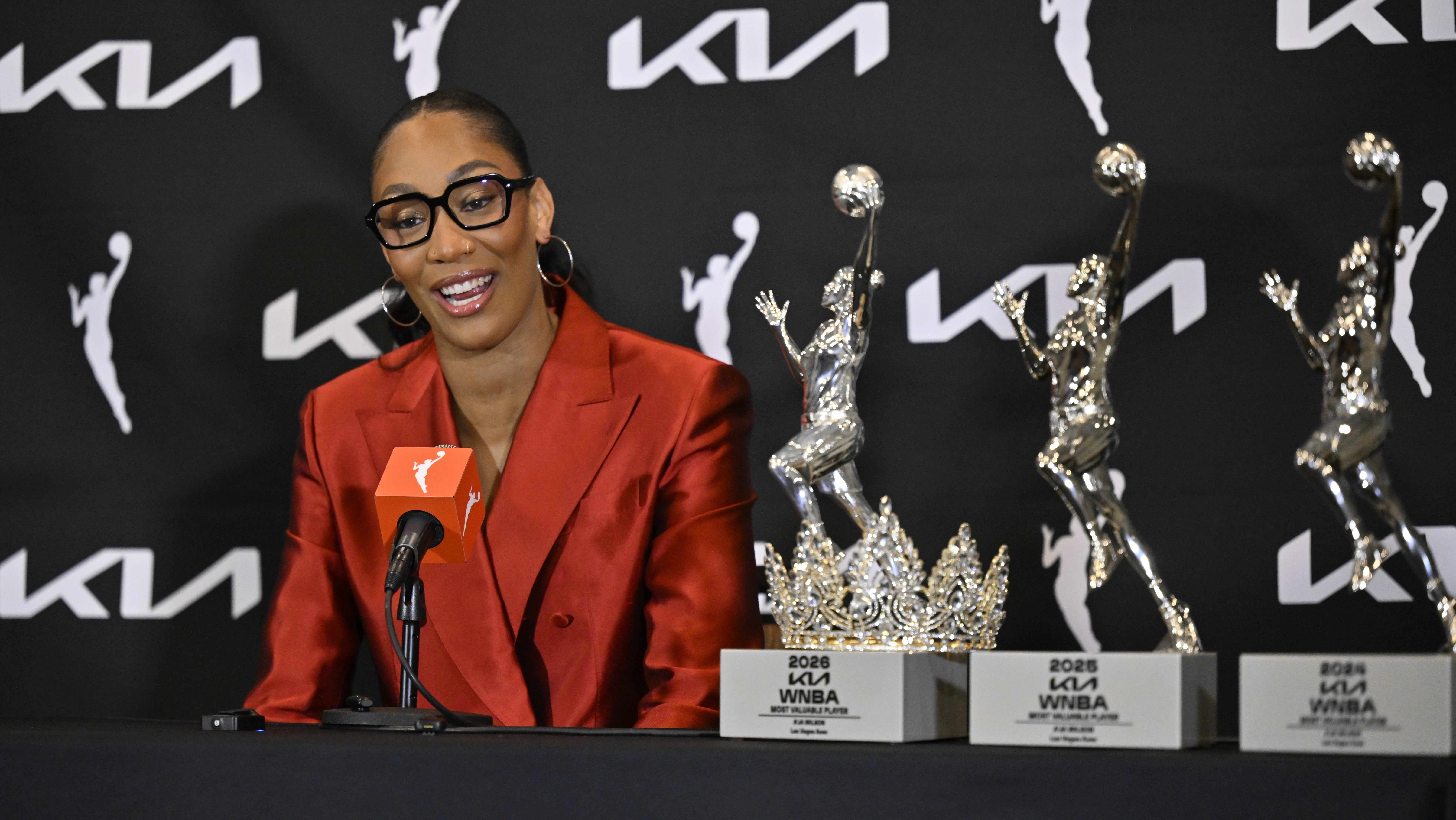
Superstars like Chelsea Gray and Sue Bird won their first rings in their third season. Diana Taurasi and Jackie Young secured titles in their fourth, while A’ja Wilson won a trophy in her fifth season after earning her first league MVP award in her third.
As Clark awaits her fourth season, she has made the playoffs each year, exiting twice in the first round. Her team made its deepest run to the semifinals during her second season, a stretch she watched from the injured list. So far, what she has put together mostly amounts to snazzy clips. To earn a starting spot in the WNBA, a player must be great. Clark is a great player, but that basic baseline standard doesn’t translate into being the undisputed greatest.
Clark fans routinely invite comparisons to NBA icons like LeBron James, Steph Curry, or Kobe Bryant, but those parallels expose her talent gap. James, Curry, and Bryant entered the professional ranks as hyped phenoms, but they quickly became complete, elite pillars who more than lived up to their billing. James became a defensive terror who could lock down an opponent while running an offense. Meanwhile, Clark consistently lacks a complete basketball package on both ends of the floor.
Since Clark’s early playoff exit this season, conservative media outlets have shifted the goalpost for greatness away from basketball metrics. The narrative has degraded into a popularity contest focused on television ratings and arena attendance, openly hinting that Clark’s squad deserved to advance simply because they bring in numbers.
If Clark can’t improve, history will look back at her impact through a precarious lens. The records may reflect that her biggest achievement was drawing a temporary audience, bolstered by a massive marketing budget, that evaporated the moment she left the floor. Her legacy will be boiled down to footage of her dashing across the hardwood with a bloody mouth after getting tangled up fighting for a rebound, flashing her injuries to curry favor and sympathy from the referees.
Ultimately, Clark’s fanbase remains trapped in a delusion of their own making. By endlessly inflating regular-season statistics and trying to rewrite history to codify her as the definitive best ever, they miss the true beauty of sports fandom.
True appreciation doesn’t require fabricating a false throne. If they could step out of their circular defensive loop, they might find what I found with Rodman: a player doesn’t need to be the undisputed ruler of basketball history or top of every stat line to be your favorite.
Instead, her supporters would rather exhaust the entire sport throwing temper tantrums over their overhyped media darling. They have become obsessed with calculating postseason arena attendance metrics for other teams, even as their own stadium seating sits at zero until next year. Since they have nothing but time on their hands during their long offseason, maybe they should spend it on Canva, designing Clark a map so she can finally figure out how to navigate a backdoor cut.
And they’d be wise to remember, not all kids become GOATs. And that’s ok.
SEE ALSO:
WNBA Playoff Run Ends For Caitlin Clark And The Indiana Fever [Op-Ed]
Why WNBA Star Kelsey Mitchell Should Leave The Indiana Fever [Op-Ed]
What's Your Reaction?
 Like
0
Like
0
 Dislike
0
Dislike
0
 Love
0
Love
0
 Funny
0
Funny
0
 Angry
0
Angry
0
 Sad
0
Sad
0
 Wow
0
Wow
0