




Alyssa Thomas, Black Masculinity, And The Realities Of Being A Masculine-Presenting Black Woman In The Workplace


Years ago, I pulled into my local gas station. I had been going there for years, and the man behind the register and I regularly exchanged pleasantries. As I walked up to the counter that morning, he looked me up and down and said, “I can tell you’re a boss at your job.”
Equal parts amused and curious, I told him I was an executive producer of a daily news radio show. I asked him how he knew I was a manager. He smiled, then said, “It’s the way you are dressed every time you come in here. You walk tall and with so much authority. You look like you mean business and tell people what to do.”
In that moment, I was flattered, and it felt like a compliment that he saw my masculine presentation, my posture, and natural stride, and he translated those traits into competence and leadership. But the reality of being a Black masculine-presenting queer woman is that his response is rare. More often than not, my experience has been that, in an employment setting, the same presentation is perceived as an active and imposing threat.
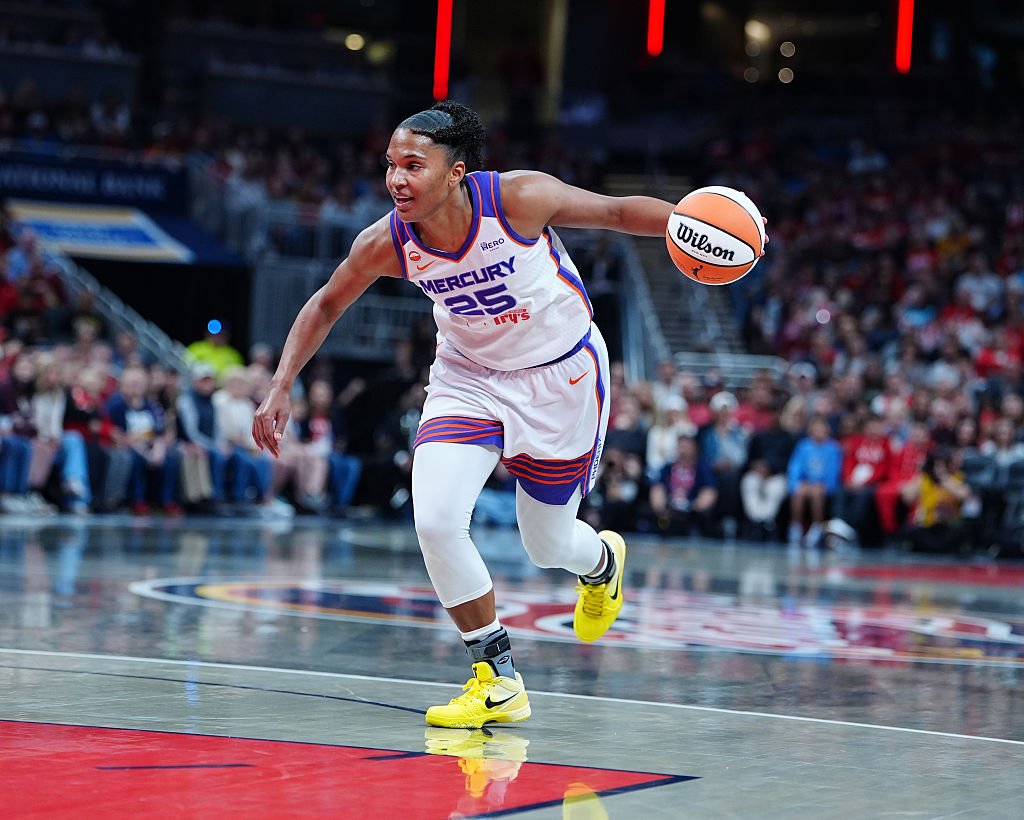
That judgment and negative stereotyping follow me across every field I have worked in, and it is why I feel a distinct kinship with WNBA’s Phoenix Mercury forward Alyssa Thomas.
Thomas is a premier athlete who stands at 6’2 and is over 200 pounds of pure muscle. She commands the game with strength and competitive fire. Basketball is an inherently physical game in which players are expected to move with heft and force.
When Indiana Fever guard Caitlin Clark lost her footing, leading to a collision with Thomas, the media and Fever fanbase turned the quick athletic play into a calculated demonization. Because Thomas’ masculine presentation disrupts heteronormative expectations, her critics twisted that same strength into caricature, reaching for words like “thug” to describe her sheer physical strength.
These caricatures are deeply rooted in historical tropes that strip Black women of our humanity, in this case reducing an elite professional’s physical power into the caricature of a violent, predatory male figure.
The public vitriol escalated into an unhinged frenzy, with critics online and in sports forums explicitly demanding that she be arrested and charged with assault for what referees decided was a flagrant foul. A still frame of the play was used as a prop by white conservatives claiming this was their George Floyd moment, a wildly unhinged comparison. I have written plenty about the play itself, and have zero interest in re-litigating it here.
The week after the incident, Thomas shared that she and her family had been on the receiving end of death threats and had been doxxed.
The toxic public perception and the hostile media narrative couldn’t be further from the truth of how she comports herself in the parts we have seen of her everyday life, where she is soft-spoken, sweet, and quiet. She routinely interacts delicately with her fans, spending extra time talking and connecting with them. She is emotionally available and gentle in those interactions, showing sincere engagement and interest in each fan she meets. She and her partner, teammate DeWanna Bonner, are raising their two children together.
This duality in how Thomas is perceived on and off the court mirrors my own life. People who know me well see my softness, tenderness, and femininity behind the masculine exterior. For Black masculine-presenting women, our presentation does not erase our capacity for tenderness, affection, and deep care, but the dominant culture and the workplaces we inhabit rarely allow space for both sides.
The public firestorm Thomas faced uncovers a much broader, documented pattern of systemic barriers that impact all Black masc-presenting women.
I have held leadership positions at national news organizations since my late twenties, a rarity in my industry. I stand 5’9 and carry a distinct, undeniably masculine presence that has been received in two completely different ways depending on my team’s makeup.
When I’ve led teams of predominantly Black and Latinx folks, I am viewed as a powerful force, a strong, savvy, and compassionate leader who gets things done. Conversely, members of white teams I’ve led have been intimidated by me, sometimes physically, and many have consistently challenged my proven expertise and authority, transforming my physicality and assured competence into a perceived threat.
To temper these defensive responses, I quickly learned to navigate a professional double standard. I purposely avoided wearing corporate suits, knowing a tailored look would be read as overly confrontational. Instead, I crafted a daily uniform of jeans, nice shoes, and a button-down shirt. I coined the term Sneaker Friday, a day when I dressed down and let my team see a different side of me. All were conscious, tactical wardrobe choices to make my presence more palatable to people who expected traditional femininity.
Sociologist Mignon Moore notes that masculine gender presentation in Black women is frequently perceived as deeply threatening to mainstream structures, leaving professionals to face continuous denunciation from a culture that devalues nonconforming expressions of identity. Thomas doesn’t have that option. Her body is her instrument on the court, and modulating her presence the way I modulated my wardrobe would mean altering the very physicality that makes her elite.
My experiences and this type of targeting are backed up by cold, hard numbers. Research data from the Williams Institute in 2025 show that more than half of Black LGBTQ employees reported experiencing discrimination or harassment at work because of their sexuality or gender identity at some point in their career. Over a quarter have experienced an adverse event at their current job, and nearly a third have heard negative comments in the workplace over the past year.
To navigate this hostility, close to 60% of Black LGBTQ workers resort to covering behaviors, which include altering their speech, mannerisms, appearance, or dress. Alyssa Thomas can’t change her uniform to hide how she presents herself, nor should she, and being physically assertive is central to her role as a basketball player in a highly competitive, physical league.
Overall, Thomas deserves to be celebrated for her talent and competitive drive. No matter how you feel about that one play, she should not be subjected to a wave of targeted vitriol that has included death threats and the exposure of her personal address on the internet.
The public harassment she has endured reflects the intersectional reality of Black masculine-presenting women across workplaces and in corporate spaces. We contend with a distinct triple jeopardy where race, gender identity, and sexual orientation intersect to ensure our natural presentation and authority are weaponized against us.
When we navigate professional spaces with strength and confidence, the dominant culture immediately defaults to a familiar script, using our presentation to reinforce the restrictive “Angry Black Woman” trope. This bias transforms our competence and masculine presentation into a threat, completely splitting how our masculinity is received when compared to men more generally.
As Mignon Moore emphasizes, masculinity does not translate into the same social or economic privileges for Black women as it does for men. For Black masculine-presenting women, it does not lead to higher earnings or automatic authority in traditional structures. Instead, it makes us a target across our identities.
Ultimately, both professional sports leagues and traditional corporate workspaces need to move past the fear of nonconformity and recognize the benefits of having both masculine and feminine energies within a single employee. True equity means recognizing that these traits complement each other in practice.
Whether we are protecting the paint on a basketball court or leading a team in corporate America, we should embrace our masculinity and quiet strength.
SEE ALSO:
Caitlin Clark Lost Her Footing, So Her Fans Called 911
Angel Reese, Izzy Harrison, And A League That Won’t Protect Its Stars
What's Your Reaction?
 Like
0
Like
0
 Dislike
0
Dislike
0
 Love
0
Love
0
 Funny
0
Funny
0
 Angry
0
Angry
0
 Sad
0
Sad
0
 Wow
0
Wow
0