





Black golf’s pro participation and the problems it faces


Listen to this story
Zero. It isn’t a score. It isn’t a handicap. It isn’t the number of putts a player hopes to take from 6 feet. Instead, zero is the number of African American golfers who competed this year in the four men’s professional major golf championships.
Zero.
In a sport enjoying unprecedented popularity, record participation and financial success, it is a number that feels almost impossible to believe. Millions of Americans are playing golf. Equipment sales continue to climb. Municipal courses are busier than they have been in decades. New golfers continue to enter the game at a pace few could have imagined just a few years ago.
Yet when the game’s four biggest stages were set — the Masters, the PGA Championship, the U.S. Open and The Open Championship — not one African American golfer was among the 283 combined competitors. It is a situation that demands both an explanation and an answer, neither of which is easy to ascertain as the PGA season closes at the FedEx St. Jude Championship this weekend.
James Beatty, editor of the African American Golfer’s Digest and executive director of the African American Golf Expo, is one of the most scholarly documentarians of the decline of African Americans on the PGA Tour.
“There were no [Black] players that qualified and there are a very limited number of players in total that are eligible: Tiger Woods, Joseph Bramlett, Cameron Champ, Harold Varner and Tim O’Neal,” Beatty said. “Tiger is limited physically and realistically can’t play, Varner is on the LIV Tour and Tim is focused on the Champions Tour. The field is embarrassingly low.”
Statistics can tell us what happened, but they rarely explain the why. To understand how golf arrived at this moment, you must rewind the story more than six decades to another time when “zero” carried a very different meaning.
Scott Halleran/Getty Images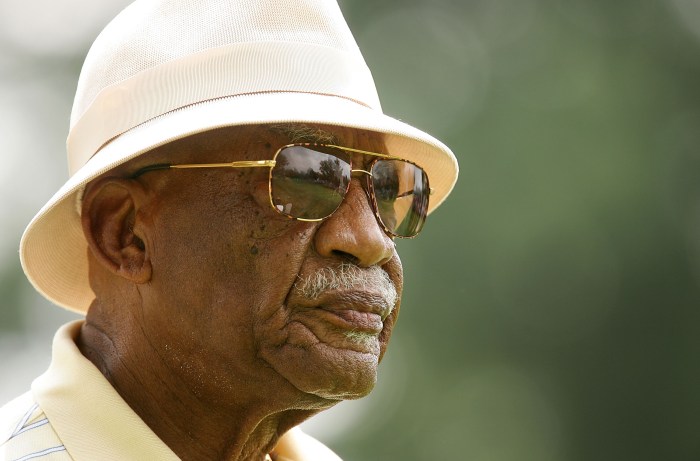
There was a time when the absence of Black golfers in professional tournaments wasn’t surprising. Rather, it was policy.
For decades, the PGA of America enforced its infamous “Caucasian-only” membership clause, a rule that kept talented Black professionals from competing alongside the game’s best. For great mid-20th-century players such as Ted Rhodes, Bill Spiller and others, it wasn’t a lack of ability that kept them out. It was a lack of opportunity.
No one understood that better than Charlie Sifford. By the time Sifford finally was accepted to play regularly on the PGA Tour in 1961, he was 39 years old. Most elite golfers today begin competing nationally as teenagers, but at age 39, Sifford was just getting started.
Despite losing the most productive years of his career to discrimination, Sifford — the first African American to earn full PGA Tour membership — still became a two-time PGA Tour winner. More importantly, he became something statistics can never fully measure. He became possibility. For every young Black golfer who picked up a club after him, Sifford represented proof that persistence could eventually overcome prejudice.
The change was slow but steady, led by Lee Elder, who became the first African American to compete in the Masters Tournament in 1975; Calvin Peete, whose extraordinary accuracy made him one of the most successful players of the 1980s; and Jim Thorpe, whose powerful personality and equally powerful golf game helped carry that progress forward. Eventually, they reached a child in Southern California whose father introduced him to a game that Sifford helped change forever.
When Woods turned professional in 1996, many viewed him as the beginning of a new era. Woods’ brilliance changed golf forever, as he won major championships at a breathtaking pace. The success of Woods created an optimism that swept through every corner of the golf industry. Participation increased to record levels, particularly among people of color. Television ratings soared. National and local golf associations, municipalities and private foundations all began asking variations of the same question: How do we create the next Tiger Woods?
But it is important to remember that while Woods inspired many to pick up a club, developing a major championship winner is an infinitely more difficult level to achieve.
Years of quality instruction, affordable access to golf courses and practice facilities, competitive junior schedules and parents willing to spend weekends driving hundreds of miles to tournaments are a mere few of the requirements just to have the opportunity to compete at the highest levels. Figure in years of customized equipment, travel expenses and coaching, and one begins to understand that the path to greatness in professional golf is primarily trodden almost exclusively by the well-heeled.
Sam Hodde/Getty Images
History has a way of making progress look inevitable. Looking backward, Sifford’s breakthrough appeared destined to happen. Elder’s invitation to the Masters felt like the next logical step. Woods’ victory at Augusta almost seemed preordained. That is why the number zero should not be viewed as an ending.
The question the sport must ask is what happens next.
Mike Whan is the CEO of the United States Golf Association, an organization that in addition to being dedicated to growth of the game nationwide is the owner and operator of the U.S. Open Championship, arguably the most prestigious tournament in the world. Whan is passionate when speaking about growing the game among nontraditional groups.
“Many more support aspects exist today that just did not 20 years ago,” he said.
He pointed to programs like the U.S. National Development Program grant for elite juniors — which gives half its funds to athletes of color — and the Grassroots Grant program, which offers significant dollars to programs that cater to underrepresented golfers.
“Perhaps even more exciting is that so many other programs exist for young athletes of color to truly pursue the game — PGA Tour Pathway to Progression, Underrated Tour, Charlie Sifford Golf Academy, PGA Jr. Leagues, Tee Divas, and others,” Whan said.
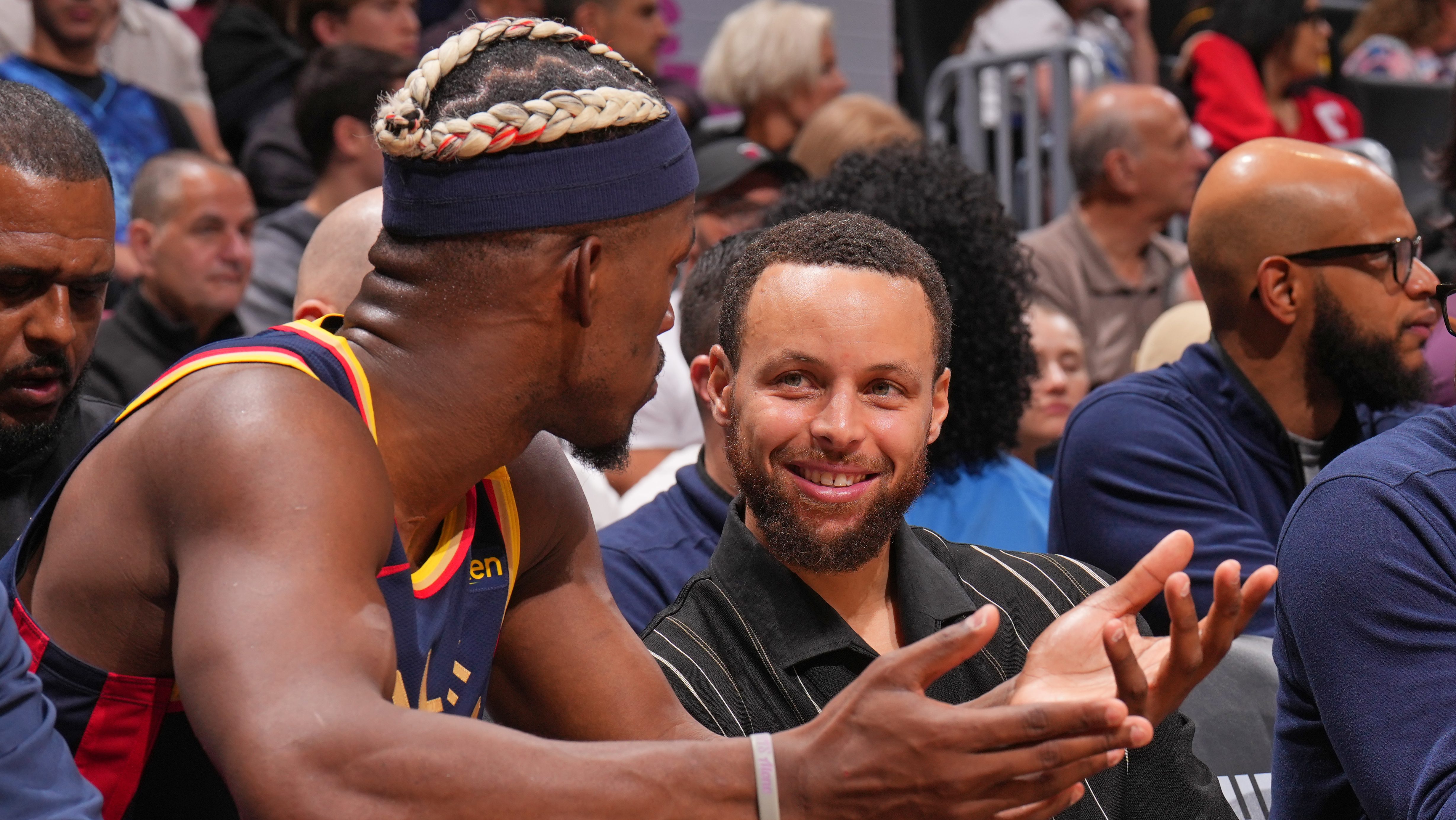
Kenyatta Ramsey, PGA Tour vice president of player development, leads efforts to diversify the sport. The tour in recent years launched programs to reach new audiences, including the Pathway to Progression junior initiative in partnership with NBA star Stephen Curry’s Underrated Tour, which supports minority golfers.
“We’re taking a larger focus the last few years, and I’m in this new role that’s specifically targeting how we identify top-level talent at all three levels — in high school, in college, and in the pros — and putting some resources behind them that helps eliminate some of those barriers to advancement that currently exist,” Ramsey said. “If you are from a different background than we normally see on television in golf, but you have the talent and the passion to make it to the top of the mountain on the PGA Tour, we’re going to do what we can to support you.
“It’s good for the game, it’s good for the impact that we can make, but it’s also good for business. As we are growing this game, we want to be able to represent America, so we’re doing a good bit of stuff. We’re making some progress.”
Greg McLaughlin is the CEO of the American Golf Industry Coalition, a division of the World Golf Foundation. The coalition unites nearly 50 allied golf organizations, advocates for the sport’s economic, environmental, charitable, and health benefits, and hosts the annual National Golf Day in Washington, D.C. As tournament director of the Nissan Open, McLaughlin gave Woods his first PGA Tour exemption.
“The AGIC brings the industry together to support initiatives that are stronger collectively than they would be individually.,” McLaughlin said. “A key initiative is Make Golf Your Thing, which is supported by golf organizations across the industry and directs resources toward expanding access to the game with communities that have historically been underrepresented in golf.
“Since launching the grant program, the industry has contributed $3.5 million to 200 unique organizations nationwide. I’m proud of the industry’s continued commitment to these types of initiatives, which open the door for more people to play, work, and do business in golf.”
Beatty views the future as a mix of challenge and opportunity.
“Golf will have to do more to make the runway to professional more accessible. It must identify young talent and intentionally nurture that talent and invest in programs that support player development,” Beatty said. “Currently, the access to professional golf is [through] college, developmental, mini-tours and qualifying school. Each one of these is tough, challenging and costly. The industry will need to continuously invest in programs and initiatives to address this lack of participation among minorities.”
Despite a shortage of minority players at the top levels, golf leaders such as Whan remain optimistic.
“I think we all knew that creating real participation momentum among girls, juniors and people of color was the first big step,” Whan said. “From there, elite individuals would start to emerge, and we’d need to have ways to support [and] nurture that growth. I think the sport is simply better aligned to capture this growth, and the potential it represents, much better than any time in our past.”
Stuart Franklin/Getty Images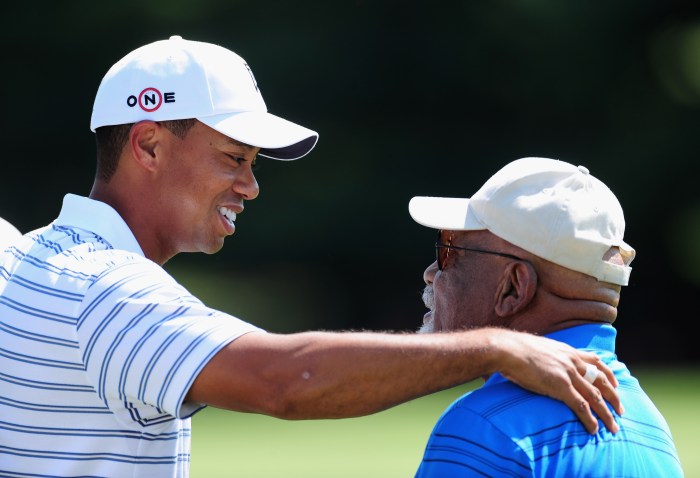
Some argue that golf is cyclical. Players come and go, and a new generation will eventually emerge. History, however, suggests otherwise. Elite golfers rarely appear by accident. They come from environments built to develop them. A successful junior golf career doesn’t begin with a college scholarship; it starts with a child who has a place to play and a mentor to believe in them.
Participation can also be a false metric when evaluating progress. Indeed, one of the dangers of measuring inclusion is assuming participation tells the entire story. Participation asks if someone picked up a golf club. Opportunity asks if they had a realistic chance to compete. The first measures access. The second measures equity.
Two generations after Sifford and one after Woods, golf finds itself at another beginning. The obvious barriers that once stood in plain sight have largely disappeared, replaced by obstacles that are both subtle and glaring. Players need ongoing access to elite equipment and coaching. Parents must somehow find the time and financial resources to spend weekends driving to junior tournaments. None of those challenges make headlines, but they determine who eventually reaches glory at Augusta National and the other major championship venues.
The game has made meaningful progress that deserves recognition. None of that should be minimized, but while progress in the game is real, it simply isn’t complete. Next comes the hardest part: faith and belief — the kind Woods inspired in millions of children watching television in April 1997. Faith and belief in future Black and Brown competitors and in the sport that provides the goals to which they aspire.
It is the kind of faith and belief that the game has had before … and must now earn once again.
The post Black golf’s pro participation and the problems it faces appeared first on Andscape.
What's Your Reaction?
 Like
0
Like
0
 Dislike
0
Dislike
0
 Love
0
Love
0
 Funny
0
Funny
0
 Angry
0
Angry
0
 Sad
0
Sad
0
 Wow
0
Wow
0