




On Tiffany Woods, Disaster, Displacement, And Life Without Parole



Last month, Tiffany Woods was denied parole again, nearly 20 years after Hurricane Katrina exposed just how fragile this country’s disaster response systems really are, revealed how Black life is devalued here, and laid bare the razor-thin margin between stability and collapse for so many Black families.
The storm has been folded into history books, documentaries, and anniversary specials, finally being framed as a long-overdue reckoning. But Woods remains in a Louisiana prison, serving a mandatory life sentence for the death of her infant son, a baby born too soon and already fighting through serious health challenges before the floodwaters ever rose.
Time has softened the national memory of broken levees, flooded streets, and families waving from rooftops in New Orleans, turning catastrophe into commemoration. But it hasn’t softened the state’s position toward Woods. Each denial of her release feels less like a legal formality and more like a declaration: that when Black mothers buckle under the weight of poverty, displacement, and impossible circumstances, their suffering will be interpreted as personal failure. And that the answer to that suffering will be punishment instead of care, repair, or accountability from the systems that unraveled around them.
Before Katrina was folded into textbooks and anniversary panels, before it became a symbol of devastating government neglect, Tiffany Woods was a young Black mother in New Orleans caring for a medically fragile baby with very little support, even then. Her son was born on June 23, 2005, weighing just over 3 pounds and needing follow-up medical attention that was interrupted when the storm descended on the city.
As evacuation orders loomed, Woods and her partner drove to Shreveport with their four children, trading one uncertainty for another and hoping that distance would equal safety. In the months that followed, they cycled through shelters and temporary housing, trying to manage the complex needs of a premature infant without consistent medical oversight.
Heartbreakingly, Little Emmanuel later died of malnutrition after the family’s formula vouchers ran out and they began feeding him diluted organic cow’s milk. Woods described that period in language that feels painfully familiar to anyone who has ever parented under pressure and distress: “I was in survival mode,” she said. As a Black mama, I know that “survival mode” is the language of triage, of doing what you can with what you have, even when what you have isn’t nearly enough.
I can’t read those words without returning to my own early months of motherhood. My daughter was also born prematurely, weighing just over 1 pound when she entered the world. Her body was so tiny that my wedding band could slide easily up and down her arm. Even with stable housing, access to specialists, and insurance that covered her extended hospital stay, I remember walking out of the NICU with discharge instructions that felt clear on paper but completely overwhelming once I was home. I remember the fear that settled in my chest each time I laid my daughter down to sleep and each time she struggled to eat. And I remember how postpartum depression tangled itself with anxiety and exhaustion in my mind and body, turning ordinary caregiving decisions into high-stakes calculations I prayed, again and again, would add up correctly.
What brought me through those early days wasn’t some extraordinary maternal instinct; it was infrastructure and care. I was fortunate enough to be supported by a Black woman pediatrician who understood my unique parenting journey and checked in often, nurses who repeated information as many times as I needed with grace and patience, and family and friends who brought food, folded laundry, and held my baby so I could rest long enough to gather myself and be the mother I wanted to be. I had a web of support that caught me before I fell. Tiffany Woods, navigating governmental collapse, displacement, and disrupted medical care, did not.
After Little Emmanuel’s death, Louisiana prosecutors charged Woods with second-degree murder. She was convicted and sentenced to mandatory life without parole under a statute so expansive that intent doesn’t have to be proven in the way most people assume for a charge like this.
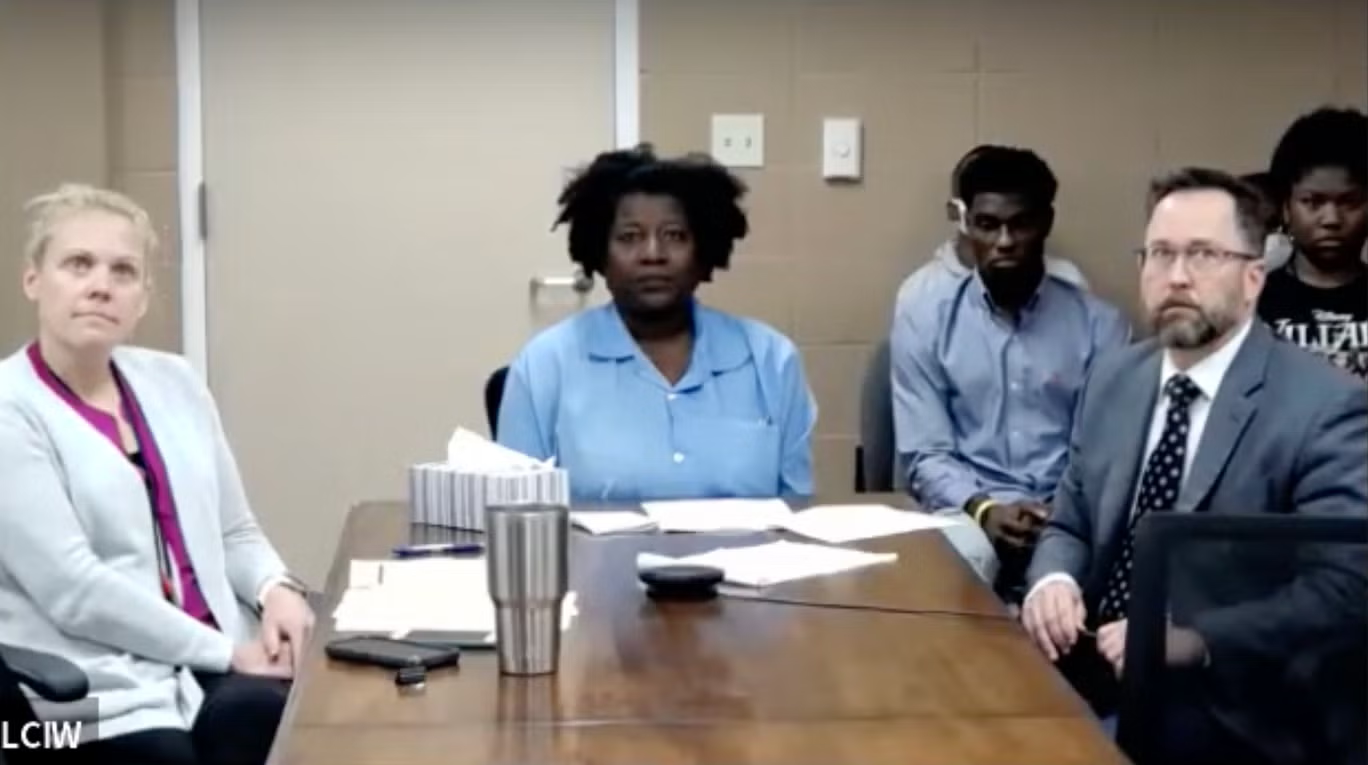
Over the years, Woods has maintained that she never intended to harm her son. At a 2023 clemency hearing, she acknowledged making “poor choices” while under the strain of evacuation and mental health crises. The Louisiana Board of Pardons voted unanimously to recommend clemency after hearing her testimony. And yet, despite that recommendation and nearly two decades of time served, Tiffany Woods has been denied parole again. The decision underscores how little room the carceral system leaves for context, for transformation, or for the possibility that tragedy often emerges from systemic neglect.
As both a prison-industrial-complex and family policing abolitionist, I believe we have to widen the lens with which we see the world and the people who live within it. Instead of only asking who to blame in cases like Tiffany Woods’s, we have to ask what conditions made harm more likely and what investments could have prevented it.
A premature infant requires coordinated follow-up care, reliable access to nutrition, and sustained guidance for caregivers, especially in the aftermath of a storm that exposed the fragility of public systems. An abolitionist response to the challenges Woods faced would have ensured uninterrupted access to formula, proactive outreach while she was displaced, home health visits to reinforce feeding guidance, transportation support in an unfamiliar city, and comprehensive mental health care for postpartum depression intensified by trauma. These are evidence-based public health interventions shown to improve maternal and infant outcomes, particularly for families facing economic instability. They represent a commitment to keeping children safe by stabilizing the adults responsible for them.
Instead of acknowledging its failure to protect Little Emmanuel and support Tiffany Woods, the State of Louisiana continues to choose punishment. Woods remains separated from her surviving children, held up as a cautionary tale in a system that too often recasts Black maternal vulnerability as criminality. Parole should not be framed as some extraordinary act of mercy here. It should be recognized for what it is: an admission that people are more than the worst moments of their lives, and that endless punishment does not foster real rehabilitation or transformation.
A pardon board has already acknowledged Woods’ growth and accountability. Keeping her behind bars will not bring little Emmanuel back, nor will it meaningfully protect other children. It only reinforces the message that when systems fail Black families, the state will respond by isolating and punishing those who were already struggling and call that justice.
Tiffany Woods should be granted parole. More than that, she should never have received a life sentence for a tragedy shaped by displacement, poverty, and fractured systems of care. If we really want to protect children, then our response to maternal crisis must prioritize support, coordination, and community-based accountability over cages.
In Woods’ case, abolition is not some abstract ideal. It’s a practical insistence that safety grows from investment in families, not from punishing and separating them.
Josie Pickens is an educator, writer, cultural critic, and abolitionist strategist and organizer. She is the director of upEND Movement, a national movement dedicated to abolishing the family policing system.
SEE ALSO:
Mother Whose Infant Died After Drinking Cow’s Milk During Hurricane Katrina Denied Parole
I Was Born In Houston, Gave Birth There, And Almost Died There
What's Your Reaction?
 Like
0
Like
0
 Dislike
0
Dislike
0
 Love
0
Love
0
 Funny
0
Funny
0
 Angry
0
Angry
0
 Sad
0
Sad
0
 Wow
0
Wow
0