

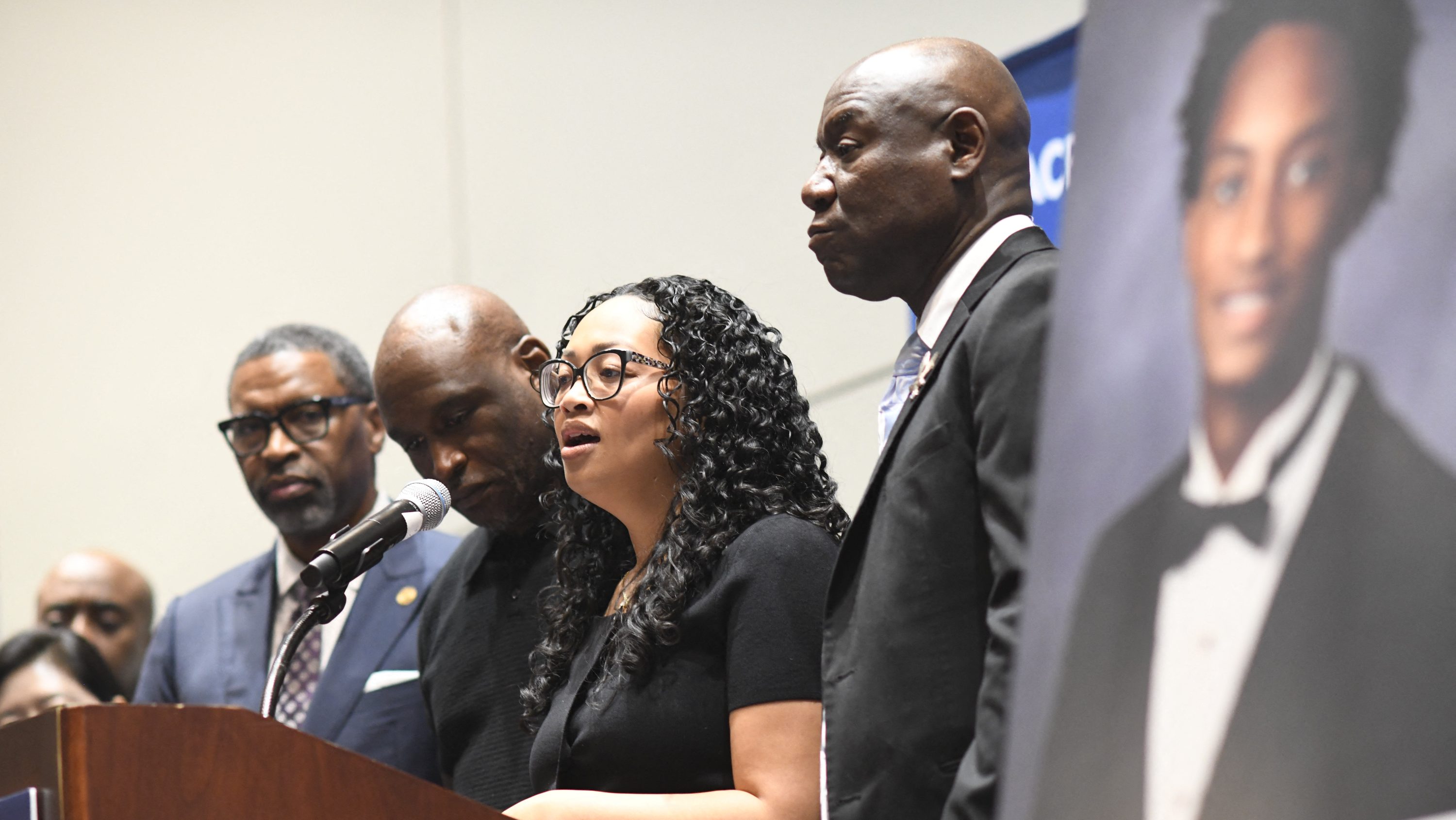











LaTosha Brown: It’s Time For A Department Of Democracy [Op-Ed]

![LaTosha Brown: It’s Time For A Department Of Democracy [Op-Ed]](https://newsone.com/wp-content/uploads/sites/22/2026/09/17895758260965.jpg?quality=80&strip=all&w=1024&crop=0,0,100,683px#)

The right to vote is more than a procedural mechanism—it embodies our most sacred democratic principle: that the government derives its legitimacy from the consent of the governed. When this right is compromised, so too is the very foundation of our republic. True architects understand that foundations matter. Today, we are called to both shore up our democratic foundation and reimagine the structure built upon it.
This urgent appeal is made in the face of persistent assaults on voting rights. While there have always been efforts to roll back the clock on democratic participating and voting access, the fight escalated dramatically in 2025. For instance, the Safeguard American Voter Eligibility (SAVE) Act represents one of the most serious threats to voting access in decades. Among other things, it requires proof of citizenship to register to vote. This will disproportionately burden naturalized citizens, low-income voters, and elderly Americans who may not have the required documents. It could also impact people who possess the required documents, but whose names do not match the information on their documents.
Additionally, the 47th presidential administration has implemented executive orders that further restrict voting access, including an order diverting federal resources away from voter outreach and education toward aggressive voter roll purges. Another order limits the Justice Department’s ability to monitor local election procedures, effectively eliminating federal oversight of potentially discriminatory practices.
This is a moment to not only defend the gains won by our ancestors, but to reimagine the next phase in the civil rights struggle.
For several years, I have explored establishing a Department of Democracy, a quasi-governmental independent entity similar to the Federal Reserve to ensure elected officials cannot easily dismantle or ignore citizens’ voting rights. Initially conceptualized as a cabinet-level department like Homeland Security, I now believe it should operate with greater independence from the executive branch to insulate it from partisan manipulation across changing administrations.
This department would serve as a guardian of democratic participation, focused solely on maximizing citizen engagement in our democratic processes. It would have the authority to set minimum standards for ballot access, oversee redistricting to prevent partisan gerrymandering, and ensure that every eligible voter can exercise their constitutional right without equitable barriers—much as building codes ensure that structures are sound and accessible to all.
We can imagine the future by developing a 2100 Vision. The vision must include:
· Structural Reforms: We must implement automatic and same-day voter registration, ranked-choice voting, and universal voting, and also eliminate the Electoral College. These are systems that expand citizens’ opportunities to participate rather than restrict them. In a true democracy, each citizen can vote for their elected leader; however, in the U.S., voters cast a vote for presidential electors who then vote on behalf of individual citizens. In some states, members of the Electoral College are expected to vote in the same way that the majority of voters in their state voted. This practice must end.
· Universal Civic Duty Voting: As a cornerstone of our Vision 2100, we must advance toward universal civic duty voting. Universal voting is a transformative reform successfully practiced in over 20 democracies worldwide. While we support incremental reforms like automatic and same-day registration as critical steppingstones, universal voting represents our ultimate democratic destination.
This approach treats voting as a civic responsibility similar to jury duty, making participation the default for eligible citizens while providing appropriate accommodations for those who cannot participate. Research shows this would dramatically increase representation across all demographic groups, reduce polarization, neutralize voter suppression tactics, and fundamentally alter campaign dynamics to focus on substantive issues rather than base mobilization.
· Local Engagement: We must secure representation on local election boards and among election officials, poll workers, and governing bodies in charge of elections. This democracy machinery operates in our counties and municipalities, and control of these processes determines whose votes count and whose are suppressed.
· Liberation Summer: We need to create community circles, gatherings, and Saturday schools to talk about power, voting rights, and our vision for the future. Just as freedom schools educated citizens during the Civil Rights Movement in the 1950s and 1960s, these spaces for political education will build the collective consciousness needed for sustained activism.
· Judicial Reform: Legal scholars suggest expanding the Supreme Court to force coalition politics instead of dominance by either party. Our judiciary must reflect our diverse population and protect fundamental rights rather than enabling their erosion. Additionally, it may be time for ethics standards to prevent Judges from legislating partisan political agendas.
· Full Representation: Grant statehood to the District of Columbia, Puerto Rico, and the U.S. Virgin Islands to ensure all Americans have equal representation in our democracy. The denial of full political rights to millions of American citizens in these territories is a stain on our democratic credentials.
· A New Southern Strategy: The U.S. South has historically been both the epicenter of voting rights struggles and a laboratory for democratic innovation. As I’ve previously argued, “As goes the South, so goes the nation” (Brown, 2020a). Targeted investment in southern organizing, infrastructure, and leadership development will be essential to any national voting rights strategy, creating models that can be replicated nationwide.
· Economic Democracy: Voting rights cannot be separated from economic justice. We must explore frameworks that connect political representation with economic opportunity, recognizing that political rights remain vulnerable to coercion and suppression without economic security.
What I’m articulating is a blueprint for democratic renewal that both addresses urgent threats to voting access and proposes transformative solutions. This plan articulates a pathway to full representation for all Americans. Afterall, American citizens are the architects of democracy, not just mere participants. If we implement these recommendations, we will be closer to building a democratic system that genuinely reflects the will of all people.
LaTosha Brown is an organizer, political strategist and co-founder of Black Voters Matter. She penned the Architects of Democracy chapter from the forthcoming book, The Black Papers: A Policy Agenda for Black Liberation in the 21st Century.
What's Your Reaction?
 Like
0
Like
0
 Dislike
0
Dislike
0
 Love
0
Love
0
 Funny
0
Funny
0
 Angry
0
Angry
0
 Sad
0
Sad
0
 Wow
0
Wow
0