![Trump Didn’t Win The Nobel Peace Prize, So He’s Helping Smear The Woman Who Did [Op-Ed]](https://newsone.com/wp-content/uploads/sites/22/2026/10/17915758433969.jpg?quality=80&strip=all&w=1024&crop=0,0,100,683px#)








Crossing The Threshold: ‘Sinners’ Surreal Montage Unveils Connection Between Ancestral And Modern Black Music, Dance

In the hushed moments before the Surreal Montage in Ryan Coogler’s Sinners becomes a portal that transcends time, space, and language, Delta Slim leans toward Sammie and says, “Tell ’em who you are, where you from.”
It lands like advice, but it feels closer to ritual instruction.
Because in Black music, especially the blues, where you’re from is never just geography. It’s inheritance. It’s lineage. It’s the sound of a place living inside the body. The weight of a grandfather’s hands. The rhythm of a church tambourine. The sway of a second line. The ache of a train whistle cutting through Mississippi humidity at night. To say who you are is also to say who carried you here.
And before Sammie even touches the mic, the room is already breathing together. Sweat hangs thick in the air. Cigarette smoke drifting beneath amber light. Somebody stomping rhythmically on the floorboards with hard-bottom shoes. Somebody laughing too loudly near the bar. Somebody already halfway gone inside the music before the song even begins.
The room feels alive. Not crowded exactly, but full. Pulsating. Like everybody brought something with them, and the room is trying to carry it all at once. Grief. Lust. Exhaustion. Loneliness. Joy. The bass is already moving beneath people’s feet before anybody notices it consciously. A low vibration traveling upward through old wood and into the spine.
And somehow all these separate bodies begin swaying, leaning, and pushing into bodies, surrendering themselves to one loose, human, nonrobotic pimp-strut groove.
Delta Slim seems to understand that the room is already leaning toward something larger than performance – something instinctive, something visceral. Something holy.
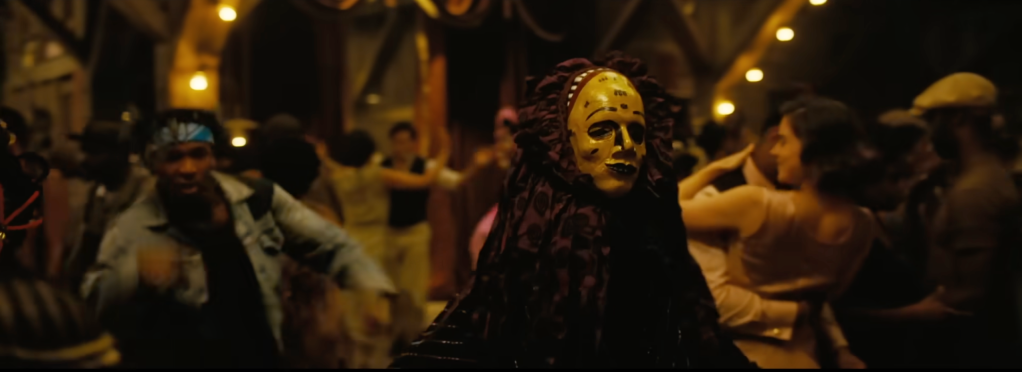
And that is exactly what Ryan Coogler’s Surreal Montage in Sinners begins to uncover. The sequence doesn’t move like a history lesson. It moves the way memory does, vivid, out of order, alive. African drummers, bluesmen, breakers, DJs, twerkers, C-walkers, second-liners, masked dancers, and future-funk spirits crowd into the same trembling room at once, as if time itself can’t hold the groove together anymore.
Amiri Baraka argued in Blues People that the deepest African continuities survived slavery not through monuments, archives, or institutions, but through nonmaterial practices carried in music, dance, religion, rhythm, and communal life. As Baraka contends, “Only religion (and magic) and the arts were not completely submerged by Euro-American concepts. Music, dance, and religion do not have artifacts as their end products, so they were saved.”
That idea becomes the spiritual engine of Coogler’s montage.
The body remembers what the archive could not hold.
Kelly White, a New Orleans-born dancer and educator rooted in diasporic practice, put it even more plainly: “The body doesn’t lie.”
What makes the montage in Sinners so overwhelming is its refusal of chronology. Coogler does not stage Black music history as a clean line moving from past to present. He stages it as a spiritual crossroads where everything happens at once. Blues guitarists stand beside African drummers. A second-line spirit glides past a breaker. DJs, Memphis jukers, twerkers, C-walkers, and modern dancers all move through the same trembling room as though they crossed through some rhythmic portal that dissolved time itself.
The sequence feels less like a lesson and more like possession. Less like documentary and more like collective memory catching the Holy Ghost.
Baraka’s point wasn’t simply that Black music “came from Africa.” That would flatten the complexity of what survived. His deeper insight was that Black expressive forms mutate because Black life mutates, while older rhythms survive underneath the transformation. Repetition. Call-and-response. Improvisation. Syncopation. Ecstatic release. Communal rhythm. Spiritual crossing.
The montage doesn’t show Black music history as a timeline. It shows it the way Baraka understood it: as a series of transformations carrying older rhythms into newer conditions. That’s why the scene moves so fluidly from African drumming to funk, from second-line procession to hip-hop, from masking to C walking. Coogler is not carelessly collapsing these forms. He’s revealing the deeper rhythmic intelligence moving beneath all of them.
Kelly White gave me another language for this. “Where we think in compartments,” she told me, “spirit is one.” That may be the clearest way to understand Coogler’s montage. The film does not separate Africa from New Orleans, blues from Bounce, C walking from ritual, or past from future. It lets spirit refuse the categories.
Traditional archives preserve objects. Museums preserve paintings, documents, instruments, clothing, and photographs. But many Black cultural traditions survived through forms that could not be easily locked behind glass. They survived because they were already portable systems of inscription. The knowledge did not depend on paper, monuments, or institutional preservation. It lived in coordinated bodies, rhythmic memory, repeated gesture, and communal performance.
The text moved before it was ever written down.
Kelly White called the movement, the music, and the drum the holders of the magic. Not decoration. Not entertainment. The holders. The vessels. The carriers.
That is the deeper brilliance of Black cultural survival across the Atlantic world. The drum could be outlawed. The language could be fragmented. The shrine could be burned. But the rhythm could still live in somebody’s shoulders. The procession could still survive in somebody’s feet. The prayer could still hide itself inside a bassline, a moan, a stomp, a sway, or a shout.
Again and again, the people I spoke with described these traditions not as performance alone, but as something spiritual, communal, and deeply lived. Jazz Johnson, founder of Twerk NOLA, told me that movement can be taught, but the spirit of it can’t. She described New Orleans shakedown spaces simply: “This is people’s church.” Shelby “GameOva” Skip Skipper, one of the defining carriers of New Orleans Bounce dance, offered the clearest instruction: “Let the beat use you.” And in Los Angeles, thinking through the relation between church ecstasy and ecstatic dance in the street, Boomer da Clown put it in the plainest possible language: “Ain’t no different.”
Ain’t no different between catching the Holy Ghost in church and ecstatic dance under the authority of the street, because the street is archive, altar, procession route, and ancestral ground.
Kelly White said it another way: “You don’t need to be in church to feel God.”
Chief Ayanda Ifadara Clarke, percussionist, educator, and chief installed in Osogbo, Nigeria, drew the line between spectacle and embodied cultural literacy this way: “Performative without intention doesn’t necessarily hold the same weight.” Speaking during DanceAfrica in Brooklyn, he described “cultural scientists,” people who understand how rhythm, repetition, procession, and communal energy can be directed intentionally rather than accidentally. That distinction sits at the center of Sinners. The groove is not random. The room is not random.
Something is being called in.
That is the cosmology Coogler is staging. What he gives us in the montage is not simply Black creativity, but Black continuity.
The body became the storage site of culture itself. More than that, the body became the compositional site.
The archive? That’s just paperwork.
The real text lives in bodies, written and rewritten through rhythm, gesture, procession, call-and-response, ecstatic release. The body doesn’t just remember. It writes, authors, and transmits.
The sacred escaped into the body before the archive could be burned.
Because the body was always the first site of inscription. Before Black culture could stabilize into institutional archives, it survived through embodied systems of writing: rhythm, movement, repetition, communal gathering. The archive came later.
The body carried the text first.
Think about it.
Where else was it supposed to go?
As Kelly White reminded me, what outsiders read as street culture is often a revered practice, full of work, energy, and Ashé.
The Juke Joint in Sinners is not simply a nightclub. It is a Black sacred chamber where rhythm, memory, grief, pleasure, sex, spirit, and ancestry collapse into the same room. Djinafoli often gets misunderstood outside the culture. The ceremony is not about the dancers becoming spectacular. It is about humans becoming legible to the unseen. This is a Djinafoli that rocks, repeats, and revises to call in the forces of nature, the Djinn, the Orisha, the Mpungos, the angels, God.
Down at the Bucket of Blood, inside the Hole in the Wall off the back road past the liquor store and the railroad tracks, the rent party has already turned into a full-blown revival. The room leans a little. Sweat drips from the ceiling. Cigarette smoke curls upward like incense. Beer bottles sweat beneath amber light while the bass circles itself over and over again, repetition so deep it stops sounding repetitive and starts sounding ritualistic.
Again. Again. Again.
Like the ring shout the hoodoo man was working before the folks arrived to guard this sacred place.
Like Big Freedia’s Bounce invocations, where repetition turns release into ritual, anger and stress dropping out of the body one command at a time.
And suddenly:
The room obeys rhythm.
Not metaphorically.
Literally.
Feet start moving before thought catches up. Shoulders unlock. Hips answer some ancient call older than language itself. A woman twerks with such grace and precision that the movement no longer feels performative at all.
It feels like somebody surviving out loud.
Across the floor, a young man starts C-walking, not dancing, walking. His flag tucked neatly in his back pocket, he moves smooth, shuffling perfectly inside the groove.
He walks for the homies. For the ones who didn’t make it. For everybody who needs to see someone keep moving.
Every step lands with intention. Dead cousins. Lost brothers. Neighborhood ghosts.
The movement moves through him like memory finding its way into muscle.
A Crip in Long Beach told me he walks to protect what he has. He spoke about C walking with the seriousness of the Haka, not to collapse those traditions into one another, but to name a form of declaration, invocation, grief, challenge, lineage, and communal synchronization moving through the body at once. He described the walk as ancestral, territorial, something carried. Like the Haka stopping the machinery of official order cold, the body interrupts the archive, demanding to be witnessed and reckoned with. The walk, too, transforms the body into a vessel for memory, neighborhood, dead homies, and inherited identity. Every stomp, every shuffle, every shift in rhythm carries intention.
The movement was not about entertainment.
It was about presence. Protection. Continuity.
Klown Walking carries another kind of threshold logic. It is not simply Crip Walking by another name. Practitioners explained that people from the community who wanted to dance without being read as Crips, Bloods, or gang-affiliated would say they were just clowning. Over time that protection became its own form: Klown Walking, rooted in the same neighborhoods, but understood as a kind of truce language between Bloods and Crips. It was not outside the community. It was the community finding a way to keep the dance moving without letting every step become a declaration of war.
Nobody in the room separates spirit from flesh. That separation belongs somewhere else, not here. Here, sweat functions like anointing oil. Feet preach. Bass resurrects. The horns don’t simply play notes, they summon worlds. Trumpets scream open the sky while second-line umbrellas spin like invocation somewhere between Congo Square and the future. The sacred and the profane collapse together right here. Whiskey and prayer. Flesh and spirit. Mourning and joy.
The room itself becomes one giant trembling body remembering how to survive.
Big Chief Shaka Zulu, a master Black Masking craftsman, percussionist, and stilt dancer who leads the Golden Feather Hunters in New Orleans, put the distinction sharply: “A costume you put on to cover who you are, a suit you put on to reveal who you are.” Kelly White deepened that insight when she described Black Masking suits as carrying 200 days of preparation, prayer, meditation, and shared energy. Bead by bead. Sequin by sequin. Hand by hand. So when a community protects the form, it is not protecting decoration. It is protecting accumulated spiritual labor.
Kofi Osei Williams, CEO of Asase Yaa in Brooklyn, known to me simply as Osei, gave me another version of this. For him, guardianship is not only about blocking the door. It is about building an institution strong enough to hold people. “When you have so little,” he told me, “you just want to keep it.” But what they do, as he put it, is “not really selling a product, but servicing a people.” He also insists that culture cannot survive as nostalgia. It has to move, and it has to carry people with it: “We’re doing the same thing with our people, not for our people, but with our people.”
The practitioners inside the Juke Joint protect the threshold with fierce discernment. Not simply because they are protecting a building or a neighborhood, but because they are protecting concentrated Black life force. The room holds something sacred. Something hard-earned. Something the world has repeatedly tried to consume once it recognized its value.
White America redlined neighborhoods, gerrymandered districts, and guarded schools and property with institutional seriousness for generations. But when Black people protect thresholds, territory, codes, rhythm, lineage, or communal space, it is often pathologized as “ghetto” or “uncivilized.” Rarely is it understood as cultural, intellectual, and intentional force against systems that desire the magic while abandoning the people who make it possible. Jay-Z once warned, “Please don’t die over the neighborhood your mama renting,” and he’s right to question cycles of violence. But underneath all of this sits another question entirely: what if part of what people are protecting is the magic itself?
The groove.
The memory.
The language.
The survival.
Protect the threshold like you have something worth protecting.
Because you do.
The vampires in Sinners do not arrive because Sammie is talented. They arrive because the music pierces something. The groove opens something.
The room itself becomes spiritually audible.
Sammie doesn’t merely perform the song. He opens the crossing. The room reorganizes itself around his ability to pierce the veil between memory and presence. He isn’t just an entertainer.
He’s a medium.
A conduit for what seeks to enter and move.
Baba Abdel Salaam, Executive Artistic Director of Forces of Nature Dance Theatre and Artistic Director of BAM’s DanceAfrica, once said that this is what makes the artist part of the first priestcraft: the artist studies the forces of nature and translates them into rhythm, image, movement, and song. That is Sammie in this moment. He is not simply performing inside the Juke Joint. He is opening a portal and becoming responsible for what enters.
Now the room changes.
The danger in the film is not simply appropriation.
It is access without stewardship.
The vampires do not simply want the music.
They want access to the force inside the music.
They hear the life inside the groove. The memory inside the rhythm. Sacred power moves through the room. Sammie’s song does not merely entertain; it pierces the veil between worlds. Past, future, and even future ancestors collapse into the same trembling moment. The music becomes so spiritually concentrated that it draws outside forces toward it almost instinctively, like predators smelling blood in water.
And suddenly the film stops feeling metaphorical.
Because Black cultural history is filled with forms that survived precisely because communities protected them relationally, contextually, and communally. Second lines. Masking traditions. Ring shouts. Hoodoo practices. Contemporary street forms like C walking, Klown Walking, and Krump. All of them carry coded movement, territorial meaning, lineage, and communal memory inside them.
The film does not imagine Black sacred space as culturally isolated, but relationally held.
The danger is not contact.
The danger is extraction without stewardship.
Osei sharpened that point in Brooklyn. Vampirism, in his reading, is not only about whiteness. It is about any relationship to culture built on taking without care. He spoke about people entering Bed-Stuy, buying into the neighborhood, then trying to silence the drums, police the stoops, and reshape the culture that made the place valuable in the first place. That is another version of the Juke Joint door: someone wants the life of the room, but not the people who made it breathe.
Many of these traditions were never fully open to outsiders because unrestricted access often meant distortion, extraction, surveillance, commodification, or erasure.
That tension still exists now.
The blues was once treated like contamination. Now Black rhythm circulates as global commodity.
Again and again, Black expressive culture becomes desirable precisely after being detached from the people who created and protected it.
That is the deeper horror inside Sinners.
The vampires do not enter the Juke Joint as students, caretakers, or stewards.
They arrive as consumers.
And once sacred space becomes consumable, the entire room changes.
The surreal montage in Sinners works because the nonmaterial survived.
Baba Abdel said it plain: “You can’t kill the rhythm.”
The groove survived.
The shout survived.
The break survived.
The walk survived.
The shake survived.
The spirit survived.
That is the deeper revelation sitting underneath the sequence. Not simply that Black music evolved, but that Black people found ways to carry memory, rhythm, grief, joy, spirituality, and communal knowledge through the body even when everything else was under assault. The archive could burn. The language could fracture. The sacred could be outlawed. But the rhythm could still move through somebody’s shoulders and undulate the spine into possession. The procession could still survive in somebody’s feet. The spirit could still arrive through repetition, bass, sweat, and song.
In Sinners, Ryan Coogler stages Black music and movement not as entertainment, but as survival technologies powerful enough to summon worlds. The montage becomes a vision of Black culture carrying memory, spirit, grief, joy, and ancestral continuity through the body across time itself.
The room trembles.
The body carries what history could not safely store.
The body writes the text that the archive could never hold.
The archive dreams of preservation.
But the body composes onward.
Black continuity is not nostalgia.
It is unfinished, living authorship.
The montage does not only preserve Black history.
It preserves Black futurity.
We survived, yes.
But we continue.
The inscription is not yet done.
We are still answering the question.
SEE ALSO:
The Black History Of Line Dancing
Imagining A World Where Everyone Can Dance
What's Your Reaction?
 Like
0
Like
0
 Dislike
0
Dislike
0
 Love
0
Love
0
 Funny
0
Funny
0
 Angry
0
Angry
0
 Sad
0
Sad
0
 Wow
0
Wow
0


![We’ve Been Here Before: New York City’s Racial Equity Commission [Op-Ed]](https://newsone.com/wp-content/uploads/sites/22/2026/10/17915571125512.jpg?quality=80&strip=all&w=682&crop=0,0,100,512px#)