










If Rue Were Real, You Would Have Given Up On Her: What ‘Euphoria’ Reveals About Addiction, Black Women, And The Limits Of Our Compassion

Editor’s Note: This column contains spoilers about the series finale of Euphoria.
There is a reason Elvis Presley is remembered as an icon who struggled with addiction, while Whitney Houston is still casually reduced to a punchline.
There is a reason generations can celebrate the genius of men who battled substance use, while one of the greatest voices the world has ever known is still discussed by some people as a “crackhead” before she is discussed as Whitney Elizabeth Houston.
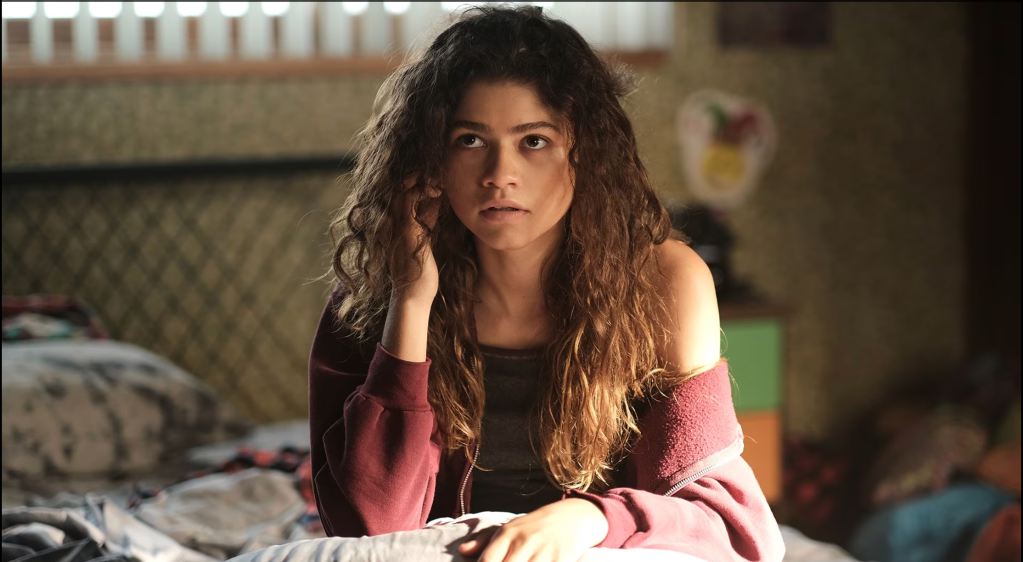
And there is a reason millions of people spent the last week arguing about whether Rue Bennett deserved a happy ending in the finale of Euphoria.
I understand the debate.
I just think people are asking the wrong question.
For days, I’ve watched viewers argue over whether Rue’s death was justified, tragic, realistic, or unfair. Some believe she was robbed of the future she fought so hard to reach. But I keep finding myself wondering why so many people were convinced a happy ending was ever waiting for her in the first place.
Rue is a young Black woman carrying profound grief after the death of her father. A young woman navigating addiction, trauma, fractured relationships, and systems that have never been particularly committed to protecting Black girls.
Yet millions of people still hoped. Not because the odds were in her favor, but because they loved her. And the more I listened to people debate Rue’s fate, the more I found myself thinking something I couldn’t shake: I don’t know that people were rooting for Rue.
I think people were rooting for Zendaya.
We can imagine redemption for beautiful, talented, beloved people. We can imagine grace for people we already value. We can imagine healing when the struggle comes packaged inside a character we have spent years loving.
What we struggle to imagine is that same grace for the woman standing in the methadone line.
The mother who relapsed. The woman who lost custody of her children. The woman whose addiction has become inconvenient. The woman everyone has already decided will never get better. If Rue were real, many of the same people mourning her would have given up on her years ago. And that realization has stayed with me because addiction is not an abstract issue for me.
My mother navigated addiction.
The first time I understood that something was wrong, I was a child. One evening, my grandmother and aunt showed up unexpectedly and asked my mother to come outside. A short time later, she was crying. A few days later, she was entering rehab.
Like many children raised in the 1980s, I wasn’t invited into the conversation. Adults handled adult business. Children figured things out afterward.
All I knew was that my mother, my superhero, was suddenly gone for thirty days. What I didn’t know was that addiction had arrived long after the pain. I didn’t know she was the only one of my grandmother’s children who never knew her father. I didn’t know she had survived sexual violence as a child. I didn’t know she had buried a first love before she ever met my father. I didn’t know the weight of all the losses she carried.
I only knew Colleen as my mother.
And I think that’s one of the greatest failures in how we talk about addiction. We often meet people at the point of impact and assume that is where the story begins. We see the bottle. We don’t see the grief. We see the behavior. We don’t see the wound.
Years later, after serving time in prison, I returned home to a family that had changed. My father had died. My mother had relapsed. This time, alcohol was the addiction. The substance was legal. The consequences were not.
I came home in February 2009. By Christmas, my mother was dead. Her alcoholism was not the only factor, but it was part of the story. And suddenly, I was grieving my mother while becoming responsible for my youngest sister.
For years, I carried anger.
I was angry at addiction. I was angry at the choices my mother made. I was angry at the wreckage left behind. Then I encountered harm reduction. And I found myself confronting a truth I did not want to face: What if judgment had never healed anyone?
What if the better question wasn’t, “Why did she drink?”
What if the better question was, “What happened to her before she ever picked up the bottle?”
That shift changed me. And nowhere was that shift more visible than on Rikers Island.
This May, I spent thirty days on Rikers. For the first two weeks, I was housed in intake alongside women navigating addiction in real time. Some were nineteen. Some were sixty-five. Some were pregnant.
Every morning, I watched women line up for methadone. I listened to women cry out in the middle of the night. I watched women fight battles most of us never see.
The women in that facility were not fundamentally different from my mother.
Or Whitney Houston.
Or Maia Campbell.
Or Rue Bennett.
The difference was not their humanity. The difference was whether society still believed they were worth rooting for. The data tells a story that many Black families already know firsthand.
Overdose deaths in Black communities rose dramatically during the fentanyl era, exposing disparities in treatment access, prevention, and recovery support. Black communities have experienced sharp increases in overdose deaths during the fentanyl era.
Women in jail and prison experience extraordinarily high rates of substance use disorder. Women in jail and prison experience extraordinarily high rates of substance use disorder.
Nearly 80% of women in jail are mothers.
And Black families remain disproportionately entangled in child welfare systems and family separation. Black families remain disproportionately entangled in child welfare systems and family separation.
Addiction does not happen in isolation. It collides with motherhood. Housing. Poverty. Trauma. Incarceration.
And Black women often experience those collisions at the highest stakes.
One of the things that struck me most after the Euphoria finale wasn’t the debate itself. It was how quickly people stopped talking about Rue and started talking about someone they loved.
Their brother. Their daughter. Their cousin. Their friend.
That’s because addiction is one of the few experiences that immediately collapses the distance between fiction and reality.
People don’t see a character. They see someone they lost. Someone they couldn’t save. Someone they are still hoping will make it.
A few months ago, Maia Campbell told me she loved me. I immediately told her I loved her back.
The exchange stayed with me because I realized I had spent years rooting for her. Not studying her struggles. Not consuming her pain. Not waiting for another relapse to become content. Rooting for her.
Hope matters. Hope is what we offer people who we still believe belong to us. Too often, Black women navigating addiction are denied that belonging. They are analyzed instead of embraced. Judged instead of supported. Reduced to cautionary tales instead of being treated as human beings whose lives remain valuable while they are still struggling.
One of the most important things harm reduction taught me is that addiction leaves very little room for nuance. At first, there is often grace. Then something shifts. Hope becomes frustration. Frustration becomes anger. And suddenly, there is room only for accountability, boundaries, distance, and consequences.
Accountability matters. Boundaries matter. Consequences matter. But our culture struggles to hold more than one truth at a time. Especially when Black women are involved.
We want addiction stories to be clean. We want them to be linear. We want someone to fall down once, get back up, learn the lesson, and never struggle again.
That’s the redemption story we celebrate. But life rarely works that way.
People relapse and still fight for their lives. People disappoint us and still deserve dignity. People can be accountable for the harm they caused while also carrying wounds that deserve compassion.
What harm reduction ultimately taught me has very little to do with drugs.
It taught me something about people. No one is ever just one thing. No one is simply a victim. No one is simply a victimizer. Rarely is the person who caused harm someone who has never experienced harm themselves.
That doesn’t erase accountability. It doesn’t excuse cruelty. But it does require us to leave room for complexity.
Human beings are complicated. Human beings contradict themselves. Human beings survive things that should never have happened to them. Human beings heal. Human beings relapse. Human beings begin again.
Recently, during a series of painful dermatological procedures, I opted to use nitrous oxide. What surprised me wasn’t that I enjoyed it. What surprised me was the relief.
For a brief moment, I understood something I had spent years misunderstanding about addiction. Sometimes people are not chasing pleasure. Sometimes they are chasing distance from pain.
That doesn’t excuse addiction. But it does require us to ask whether our response creates any possibility for healing.
My mother spent most of her life being a superhero to me. Not because she was perfect. Because she wasn’t. The older I get, the more I think perfection is one of the least interesting things a person can be.
Humanity requires far more courage.
My mother survived things she should never have had to survive.
She loved deeply. She made mistakes. She carried grief. She carried trauma. She struggled. She relapsed. She was complicated.
In other words, she was human.
And perhaps that is what addiction forces us to confront. Not whether someone is good. Not whether someone is bad. Whether we are willing to love people who are fully human.
We already know Black women are less likely to have their pain believed in medical settings. We know Black women face disproportionate maternal health risks. We know Black women are more likely to be judged through stereotypes that require endless strength while denying vulnerability. We know Black families experience disproportionate surveillance through child welfare systems.
Addiction doesn’t create that lack of grace. It reveals it. It exposes what was already there. It shows us what happens when a group of people who are already expected to carry the weight of the world is suddenly unable to carry it quietly.
Because if Black women are denied grace in the best of circumstances, what chance do they have when addiction enters the story?
The Black woman pursuing a doctorate. The Black mother raising children. The Black woman telling a doctor she is in pain. The Black woman surviving domestic violence. The Black woman running for office. The Black woman singing the soundtrack to our lives. The Black woman standing in line for methadone. The Black woman down the block.
The question is not whether they deserve care. The question is why we continue to build systems that require them to earn it.
And if we are serious about changing how addiction is addressed in this country, we should start with the people who have historically received the least compassion.
Because any model of care that works for Black women will work for everyone.
Any system capable of holding the complexity of Black women is capable of holding the complexity of human beings.
That, more than anything, is what harm reduction taught me.
Not that accountability doesn’t matter.
Not that consequences don’t matter.
But that humanity is a grace-required condition.
And any solution that forgets that will always fall short.
SEE ALSO:
What ‘Love Is Blind’ Taught Us About The Good Guy Myth
What ‘Down Low’ Discourse Keeps Us From Seeing About Harmful Men
What's Your Reaction?
 Like
0
Like
0
 Dislike
0
Dislike
0
 Love
0
Love
0
 Funny
0
Funny
0
 Angry
0
Angry
0
 Sad
0
Sad
0
 Wow
0
Wow
0


![The Lakers Look More Like The Country Club Than Showtime [Op-Ed]](https://newsone.com/wp-content/uploads/sites/22/2026/10/17924362130137.jpg?quality=80&strip=all&w=1024&crop=0,0,100,682px#)