![Of Course America Justified The Police Killing Of A Black Baby [Op-Ed]](https://newsone.com/wp-content/uploads/sites/22/2026/10/17925296479503.png?strip=all&quality=80&w=1970&crop=0,0,100,1332px#)








Why It Matters That Caitlin Clark Was On Stage With Country Music Singer Morgan Wallen


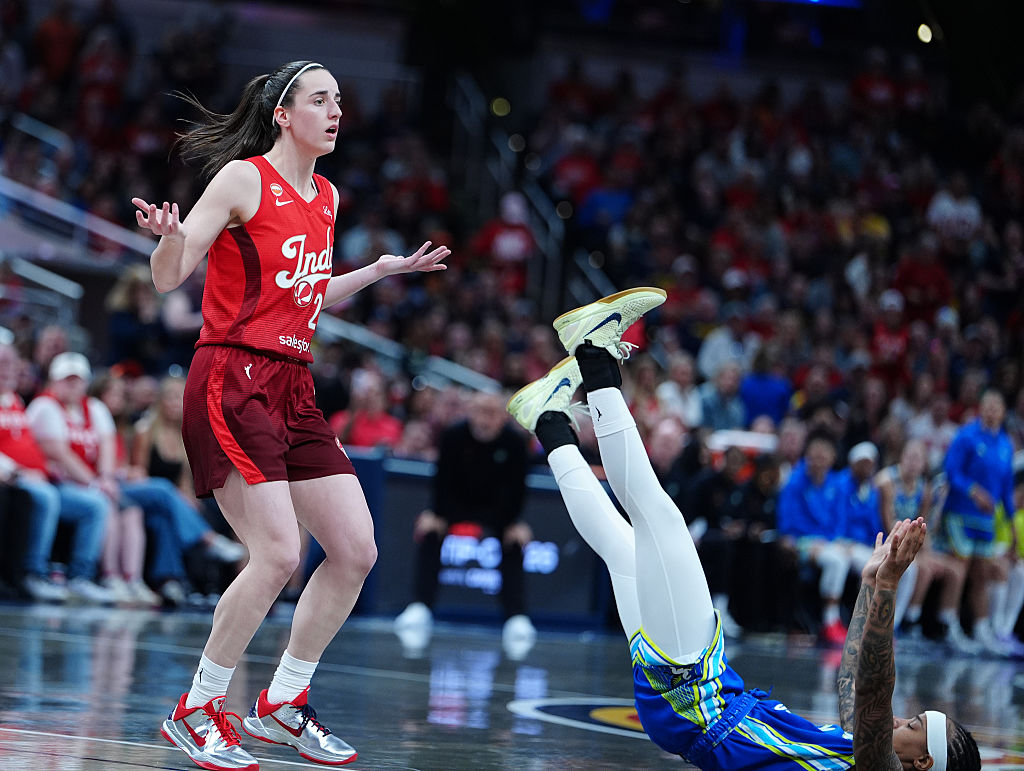
Within a span of roughly 12 hours on Saturday, WNBA player Caitlin Clark shoved one of her opponents during a game, cursed at that same player on another play, and accused her of “flopping all f-ing day”, shot a mere 22% from 3-point range, lost the season opener, and later that evening walked out onstage with controversial country singer Morgan Wallen.
Taken together, those twelve hours are not an aberration. They read and function as a compressed portrait of who Caitlin Clark has been on and off the court since her collegiate years.
With Clark’s third season in the WNBA now underway, the league continues to tout her as its biggest star, even as her production for the Fever has lagged that billing. So far, the WNBA has absorbed her on-court tantrums as quietly as possible, while its marketing campaigns continue to elevate her in ways that belie her stat lines. And her public posture toward the racism vehemently circulating in her own fan base shows that she is unwilling to take a strong position on race that might cost her a single fan.
In the Indiana Fever’s season opener against the Dallas Wings, Clark shoved Dallas Wings guard Aziaha James to the floor, and during another play when she ran into James on a drive and was called for an offensive foul, Clark was captured on camera accusing James of “flopping all f-ng day.”
The Wings went on to win the game by three points after Clark missed a crucial 3-point shot with less than 10 seconds to spare that would have tied the score and put the Fever in position to force the game into overtime.
Very little attention was paid during the game to Indiana Fever guard Kelsey Mitchell, who last season was widely lauded by sports analysts, the Fever’s coach, and the team’s front office for being a key force in propelling the team deep into last season’s playoffs.
Instead, on-air commentators regularly spoke highly of Clark and her hard work in the off-season, working with one of Steph Curry’s coaches to improve her game.
Despite all of that hard work commentators shared she was doing in the off-season, Clark admitted in her post-game interview that she was “rusty.” She finished the game with 5 turnovers, 20 points, and shot 7/18 from the field (the lowest field goal percentage of any player on her team who scored). Clark also shot 2 out of 9 or 22% from 3-point range, while Mitchell finished with 30 points, securing her spot as the lead scorer in the game.
Still, much of the post-game coverage focused squarely on Clark’s successes on the court, not Mitchell’s fantastic performance.
What’s gone viral on social media since is the clip of Clark shoving James that Clark’s fans have metabolized as unfair treatment against their star player, who, in their eyes, is a target and has every reason to feel aggrieved.
If you are Aziaha James, imagine getting shoved by and then cursed at by the most protected and entitled player in the league. Then, to add insult to injury, the clip of you getting shoved goes viral with the usual Clark fans piling on.
Clark’s outbursts on the court, and her fans’ responses, aren’t new. Recently, in a preseason game against Nigeria, as the Indiana Fever guard was dribbling the ball out of traffic, strands of her hair appeared to graze her face. The defender’s hands were visibly low, making it virtually impossible for her to have hit Clark in the face. Clark recoiled, threw her head back, and turned to the official, looking for a foul call. The replay clarified it was likely her hair that had hit her, not the defender.
Her reaction to her own hair as if it were a forearm to the face is the distillation of a longer pattern in which Clark has built a habit of performing injury where none exists.
Not even cameramen or Indiana Fever coaches are safe from her temper tantrums. In a matchup with the Phoenix Mercury last season, Clark was on the sidelines when a cameraman hunkered down in front of her with his camera and moved by her quickly. In a video captured by someone in the stands, Clark appeared to chastise him for doing so. During a different game, Clark and teammate Sophie Cunningham were captured on video rudely dismissing Fever assistant coach Briann January.
Even Clark’s father has taken issue with her behavior on the court. In 2024, during a March Madness game, Clark erupted at the referees over a call in the 2nd quarter, even while her team enjoyed a comfortable 19-point lead.
Her father, Brent Clark, fed up with her complaining, yelled from the stands, telling her to “Stop” before shaking his head in disbelief. According to a CBS sports reporter, a little later in the game, Clark’s father was heard saying, “Take her out, gosh,” after she committed an offensive foul.
The reflexive defense often offered for moments like these is that Clark is still young and is learning the demands of public life, and that her behavior should account for both. The argument is not unreasonable on its face. It loses force when you consider that the same generation of women’s basketball has produced Dallas Wings’ guard Paige Bueckers, a phenom and last year’s first round draft pick, who entered into the same machinery of high pressure and expectations, but who has met the demands of stardom without any of the same lapses in composure.
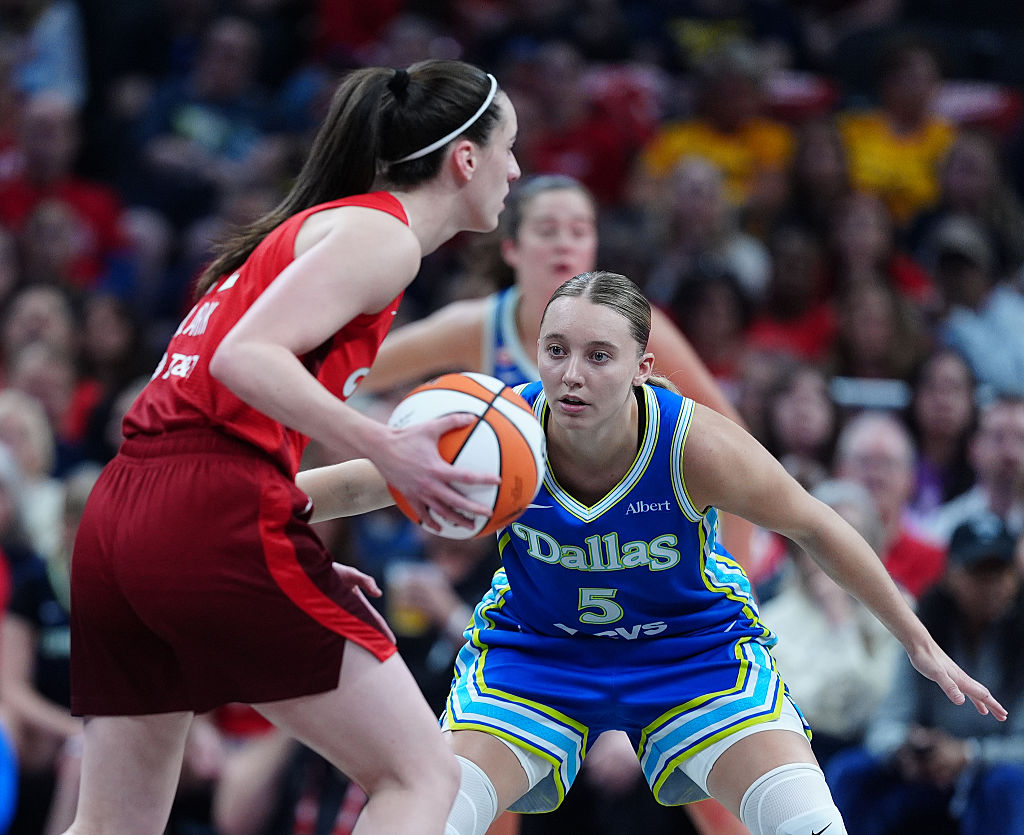
Paige Bueckers is who Caitlin Clark’s fans want her to be as a player. Who Bueckers is off the court is why Clark fans will never rally behind Bueckers with the same fervor. Bueckers doesn’t shy away from talking openly about racism, and she regularly advocates both publicly and privately for Black players in the league. In this way, Bueckers offers a working model of what it looks like to be both a great player, a leader, and a respectful colleague to the Black women who built the WNBA.
Clark spent the back half of Saturday demonstrating what the alternative looks like. That evening, not long after she walked off the basketball court at the Gainbridge Fieldhouse, Clark popped up less than a mile away, walking onstage with country singer Morgan Wallen at his tour stop at Lucas Oil Stadium in Indianapolis.
The video images of Clark walking out beside capture the weight of Clark aligning herself with what Wallen represents, on a tour he has pointedly titled “Still the Problem.” And it is, perhaps, the part of Clark’s itinerary on Saturday that deserves the closest reading.
The symbolism of their walking on stage together comes into focus only once Wallen is situated within an arc that began several years ago. In February of 2021, TMZ published footage captured by a doorbell camera of Wallen using the “N” word outside of his home in Nashville.
After the footage went viral, the country music star was temporarily dropped by his record label, Big Loud Records, which said it was suspending his contract indefinitely. Wallen released a statement to TMZ apologizing for using the racial epithet, saying, “I’m embarrassed and sorry. I used an unacceptable and inappropriate racial slur that I wish I could take back. There are no excuses to use this type of language, ever. I want to sincerely apologize for using the word. I promise to do better.”
All was forgiven by his label within a few months, and they brought him back into the fold by May of that year. Shortly after that, he returned to performing live for the first time since the video emerged, popping up as a surprise guest onstage with fellow musician Kid Rock, a proud MAGA acolyte.
Clark has also shown a pattern of using evasive language to soften blowback when asked to address her fanbase’s racist harassment of players like Angel Reese, Dijonai Carrington, and, most recently, one of her teammates, Raven Johnson.
Clark has often chosen silence instead of addressing her fans outright and telling them to stop the racist attacks against her colleagues. Other times, like Wallen, she’s delivered carefully crafted statements that have fallen short of calling for true repair or zero tolerance of racism.
In a 2024 interview for her “Athlete of the Year” cover in Time Magazine, Caitlin Clark addressed what Time writer Sean Gregory called “the racial underpinnings of her stardom.” Clark said, “A lot of those players in the league that have been really good have been Black players. This league has kind of been built on them. The more we can appreciate that, highlight that, talk about that, and then continue to have brands and companies invest in those players that have made this league incredible, I think it’s very important.”
The inclusion of “kind of” is not accidental, and it’s both a tell and a hedge. Clark’s framing acknowledges Black women without affirming them and gives a gesture without committing to their contributions as factual. The league was indeed built on the backs of Black women.
Similarly, Wallen’s apology frames his temporary time away as personal growth, and never explicitly names what he actually did or commits to direct repair with the community he slurred.
Black people will recognize this language from Clark and Wallen because we encounter it regularly. We read it in HR emails, in school district statements, and in the carefully worded responses our managers deliver after someone says something they shouldn’t have after drinking too many cocktails at the holiday party. We can therefore recognize with stunning accuracy the difference between a statement written to repair and a statement written to neutralize any hints of outrage.
In the case of both Wallen and Clark, both statements weren’t drafted to change anything about the person delivering them. They merely served as a pathway. For Wallen, that meant a pathway towards reviving his contract three months after spewing a racial epithet. For Clark, it means protecting and continuing to elevate herself as the marquee star in a league where Black women are the majority.
To be clear, not every racist says the “N” word within earshot of a doorbell camera like Wallen did with video evidence that is swiftly delivered to TMZ. Most of the racism Black people navigate at work, in school, or while waiting in line at our local coffee shop comes from people who wouldn’t dare use the “N” word to our faces, and who believe that very level of restraint makes them antiracist. Most would be insulted to be informed otherwise.
White institutions have built their entire framework for racial accountability around an incredibly narrow subset of behavior that must be filmed, played back, and litigated for it to even “count” as racist.
Everything else that occurs in integrated spaces, from the silence from white people when a Black colleague is surveilled and subject to disproportionate criticism, to who is let into the inner circle where decisions are made, to the people you decline to disavow, all gets coded as personal preference when you are white. Black people have come to recognize that self-avowed personal preference is code and a way white people attempt to shield themselves from allegations of racism.
The reading Black WNBA fans were already doing on Saturday as Clark’s day and evening unfolded was confirmed by one of her teammates. Sophie Cunningham, who has gone to great lengths to establish herself as Clark’s on-court enforcer, posted a video of Clark’s walkout with Wallen, calling her a “bad a$$ bitch” on Instagram.
This serves as yet another reminder that if you’re Caitlin Clark, you can have a day filled with losses, but walking across the stage with a country music star whose current comeback is inextricably linked with his use of the “N” word means you still won the day in the eyes of your inner circle and fans.
SEE ALSO:
The WNBA’s New CBA Is Changing The Math On Motherhood For Players
Everything You Need To Know About The 2026 WNBA Season
What's Your Reaction?
 Like
0
Like
0
 Dislike
0
Dislike
0
 Love
0
Love
0
 Funny
0
Funny
0
 Angry
0
Angry
0
 Sad
0
Sad
0
 Wow
0
Wow
0